
Key figures
- air passengers worldwide in 2025 (approximate)
- 5bn
- growth in global passenger demand, 2025 on 2024
- +5.3%
- passengers at UK airports in 2025
- 302 million
- passengers in the US, the largest air market, 2025
- 890.1m
Last reviewed 22 November 2026. Every figure on this page was checked against the sources listed at the end of the page; where two sources disagree, the difference is stated.
Around 5 billion passengers flew on scheduled airline services in 2025, according to the International Civil Aviation Organization (ICAO), on roughly 38 million flights. Demand measured in passenger kilometres rose 5.3% to a record, the International Air Transport Association (IATA) reports, and UK airports handled a record 302 million passengers, according to the Civil Aviation Authority (CAA). 2026 has been harder: the war in the Middle East pushed global demand into decline from April, and IATA now forecasts 5.1 billion passengers for the year. The figures below come from IATA, ICAO, the CAA, the ONS, the US Bureau of Transportation Statistics (BTS) and airline results, and are the latest available in November 2026.
Key air travel statistics
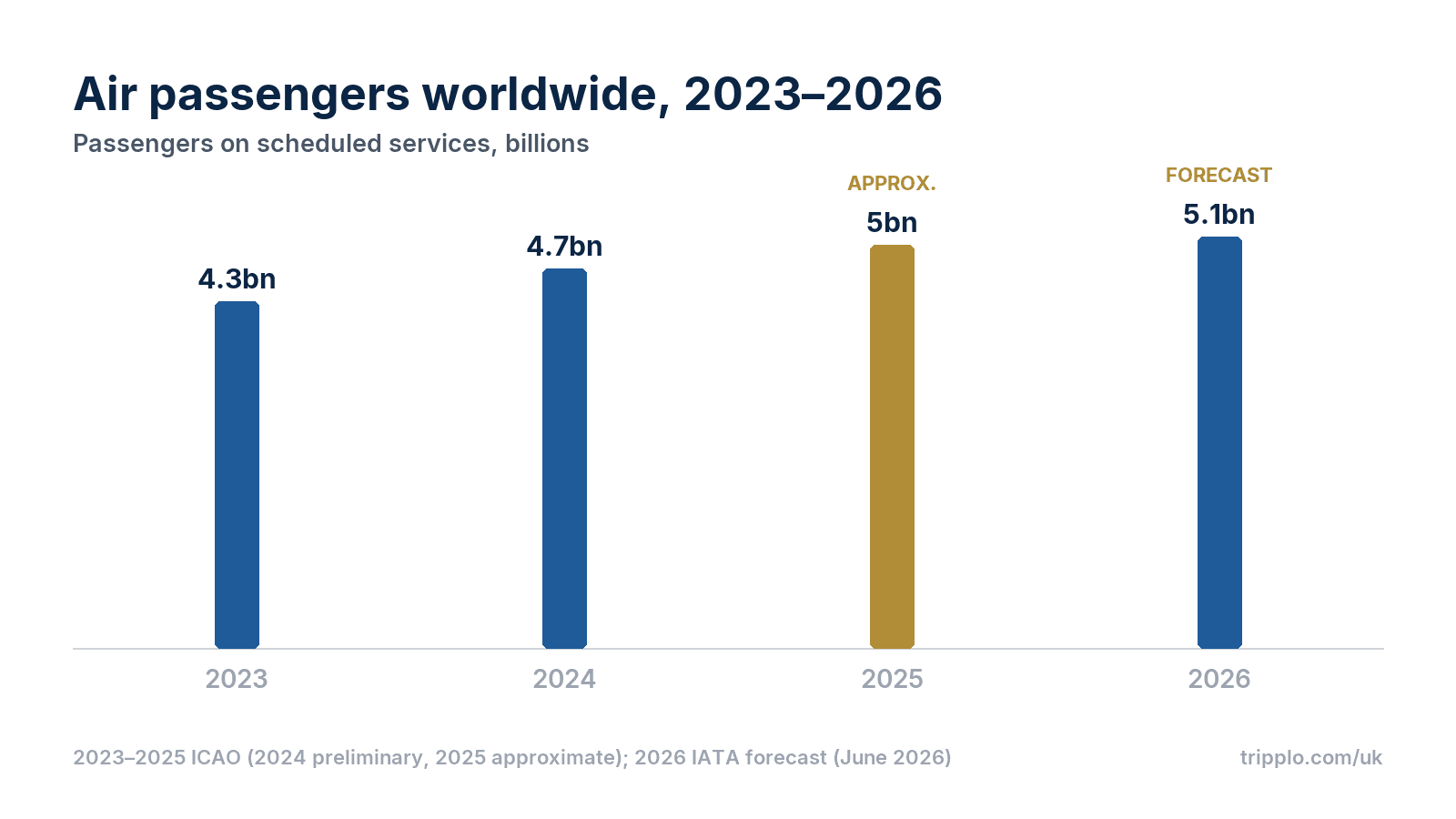
- Airlines carried about 5bn passengers in 2025, up from 4.7bn in 2024 (ICAO).
- Global passenger demand (revenue passenger kilometres, RPK) grew 5.3% in 2025, with a record load factor of 83.6% (IATA).
- The United States was the largest air travel market in 2025 with 890.1m passengers, ahead of China (776.1m) and the UK (269.7m) (IATA).
- UK airports handled a record 302 million passengers in 2025, up 2% on 295 million in 2024 (CAA).
- Heathrow was the UK's busiest airport in 2025 with 84.5m terminal passengers (CAA).
- 13% of passengers at eight of England's busiest airports were travelling for business in 2025 and 87% for leisure (CAA passenger survey).
- IATA recorded 51 accidents in 38.7 million flights in 2025, one accident per 759,646 flights (IATA Safety Report).
- IATA forecasts 5.1 billion passengers in 2026, up 2.4%, after cutting its December 2025 forecast of 5.2 billion (IATA).
How many people fly each year?
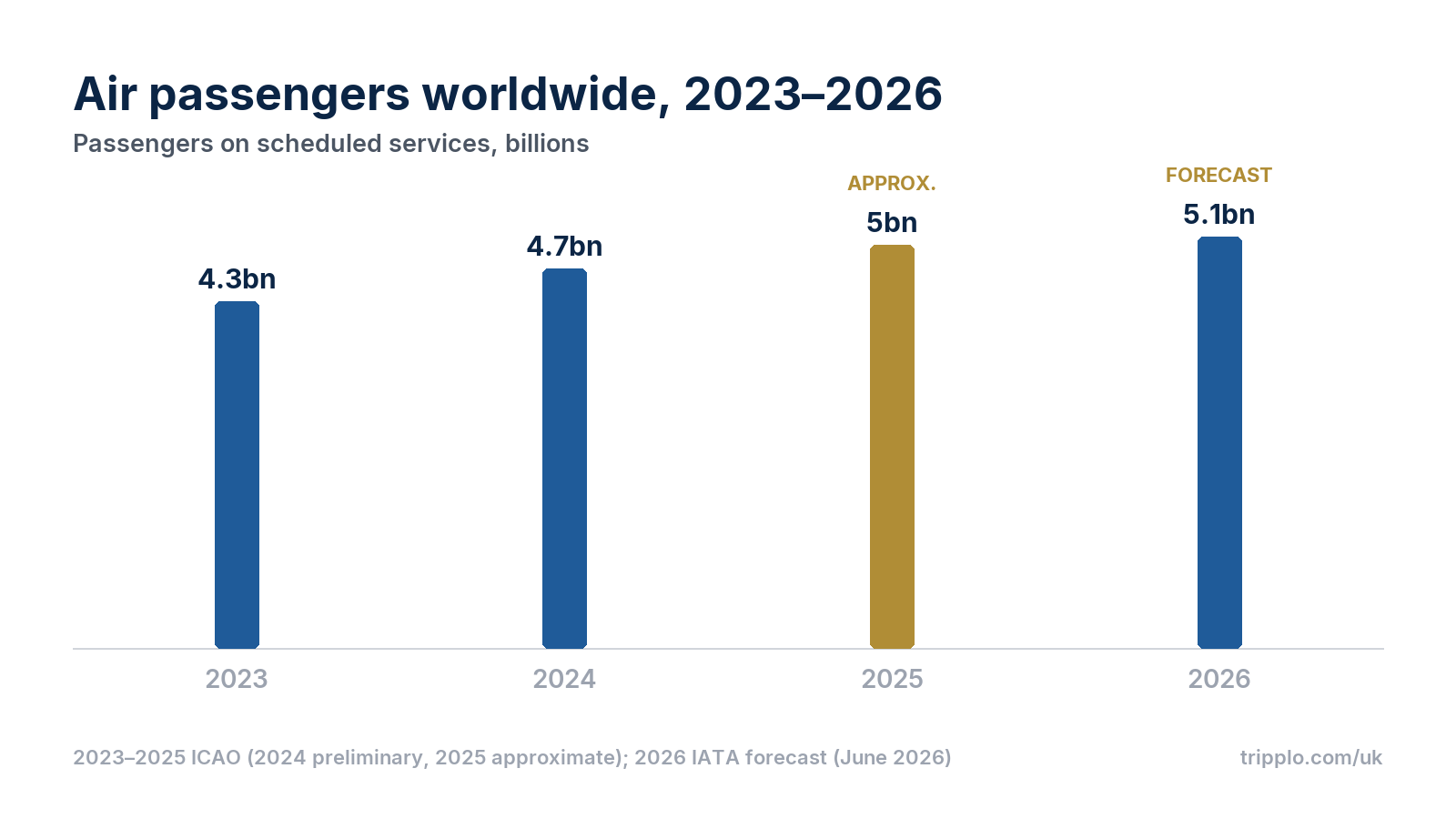
ICAO counted 4.3bn passengers on scheduled services in 2023, 32.4% more than in 2022, on 35.3 million departures. Its preliminary figure for 2024 was 4.7bn, up 7.9%, on 37.4 million departures. For 2025, ICAO's safety report puts the total at approximately 5bn passengers on about 38 million flights.
- IATA's full-year 2025 data show demand up 5.3% and capacity up 5.2%, giving a record load factor of 83.6%.
- International traffic grew faster (+7.1%) than domestic traffic (+2.4%) in 2025.
- Africa grew fastest (+9.4%), followed by Asia-Pacific (+7.8%), Latin America (+7.0%), the Middle East (+6.8%) and Europe (+5.3%). North America, however, managed only +0.4%.
- Among domestic markets, Brazil grew fastest (+11.1%), while US domestic demand fell 0.6% (IATA).
- For 2026, IATA expects 5.1bn passengers, up 2.4%, and record total industry revenues of $1.165 trillion.
Air travel in 2026: the Middle East war slows growth
- Global demand fell 3.4% in April 2026 compared with April 2025. Excluding the Middle East, demand still grew 1.2%; demand for Middle Eastern carriers fell 46.6% because of the war in the region (IATA).
- The decline narrowed through the year: September 2026 demand was down 0.5% on September 2025, or up 0.3% excluding the Middle East. Domestic traffic fell 2.2%, with US domestic demand down 2.7% and China's up 3.1% (IATA).
- Fuel is the main cost pressure. IATA expects the airline fuel bill to rise from $252 billion in 2025 to $350 billion in 2026, and has cut its 2026 net profit forecast to $23.0 billion, about half the $41 billion it expected earlier and the $45 billion earned in 2025.
- Net profit per passenger is forecast to fall from $9.10 in 2025 to $4.50 in 2026 (IATA, June 2026).
- The UK started the year strongly: more than 61 million passengers used UK airports in January to March 2026, about one million more than a year earlier and the busiest first quarter on record (CAA).
The world's largest air travel markets
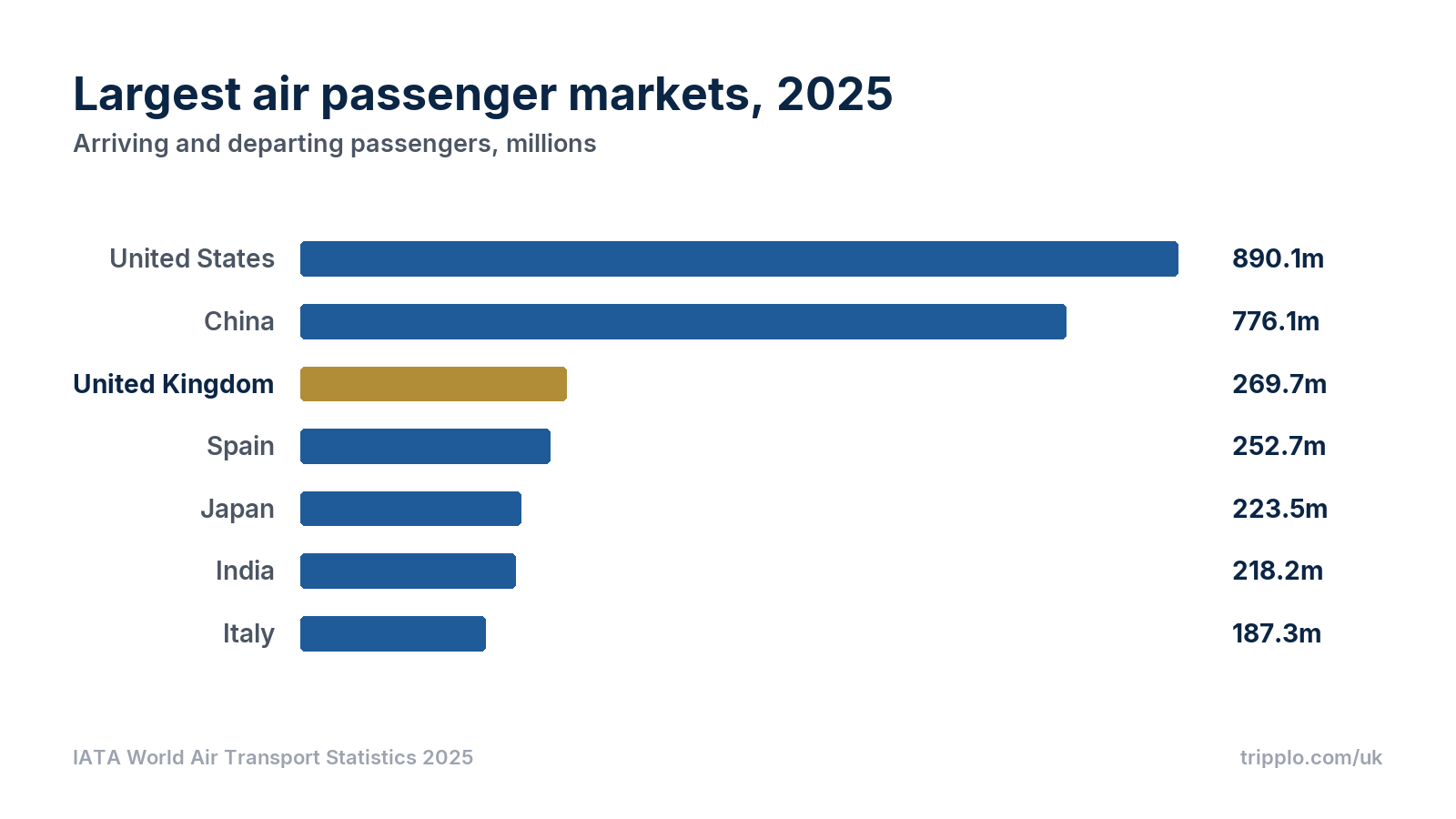
IATA's World Air Transport Statistics rank countries by arriving and departing passengers. The UK is the third-largest market in the world and the largest in Europe.
- United States: 890.1m passengers in 2025 (+1.6%, the slowest growth in the top 10); 876 million in 2024.
- China: 776.1m (+4.8%); United Kingdom: 269.7m (+3.4%); Spain: 252.7m (+5.0%).
- Japan (223.5m, +9.2%), India (218.2m, +3.3%) and Italy (187.3m, +5.8%) follow, ahead of Germany (163.8m), France (152.6m) and Türkiye (129.3m).
- Kazakhstan (+40.0%) and Uzbekistan (+16.9%) were the fastest-growing markets in 2025.
- The busiest route in the world was Jeju to Seoul Gimpo with 13.3 million passengers. In Europe it was Barcelona to Palma (2.1 million), and the busiest international route from North America was New York JFK to London Heathrow (2.1 million).
- Among Europe's low-cost airlines, Ryanair carried 208.4 million passengers in the year to March 2026 (+4%) and expects 216 million in the following year. easyJet carried 93.4 million in the year to September 2025, up from 89.7 million, at a load factor of 89.8% (company results).
The UK figure from IATA (269.7m) is lower than the CAA's airport count (302 million) because the two are measured differently: the CAA counts passengers at each UK airport, so a domestic passenger is counted at both the departure and the arrival airport.
UK airports and passengers
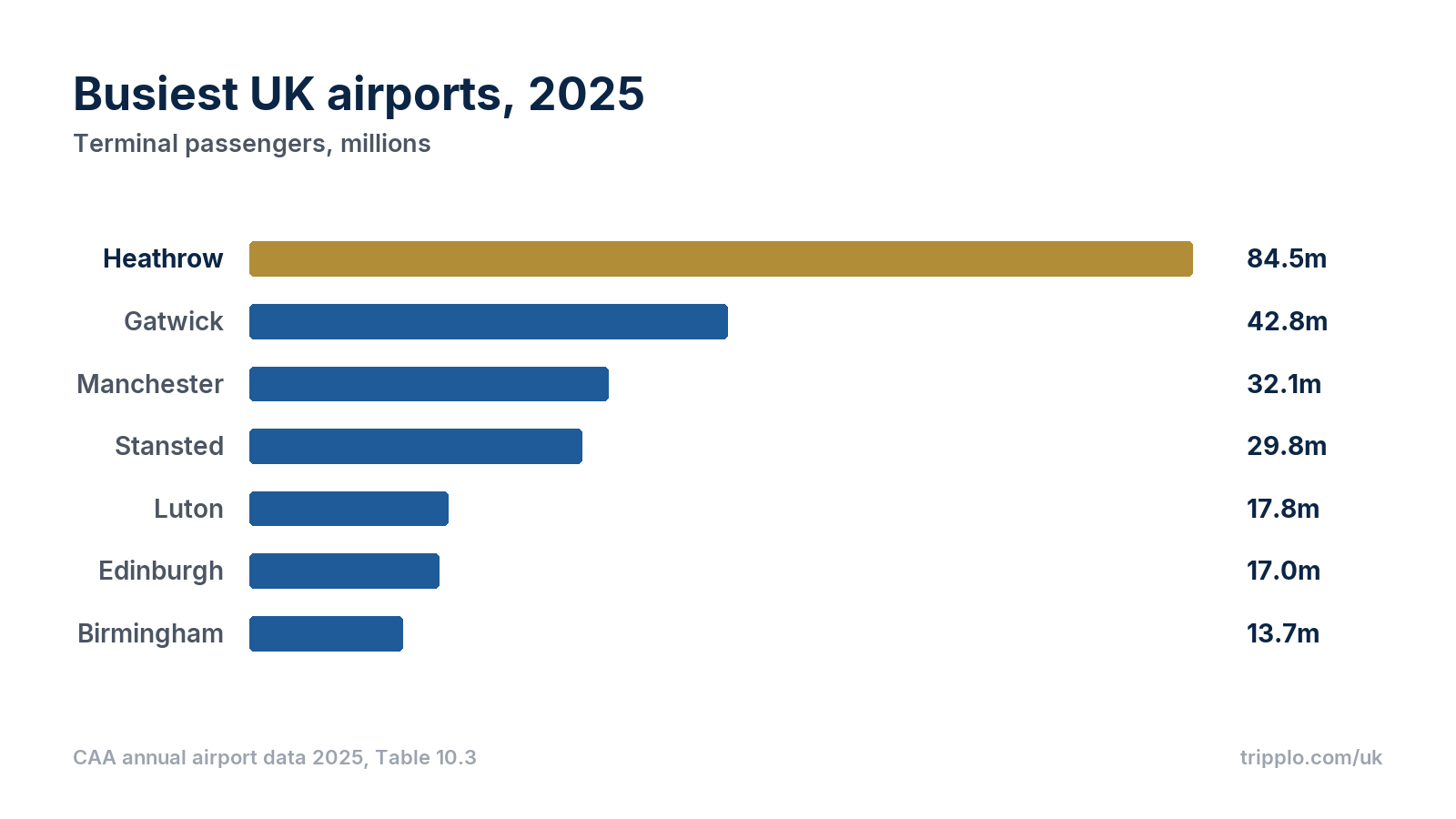
The CAA reports that 302 million passengers passed through UK airports (including the Crown Dependencies) in 2025, 2% more than the 295 million of 2024 and the highest level on record. Passenger numbers have tripled since 1989.
- Heathrow handled 84.5m terminal passengers in 2025 (+0.7%), followed by Gatwick with 42.8m (-1.1%) and Manchester with 32.1m (+4.2%) (CAA).
- Stansted (29.8m, +0.2%), Luton (17.8m, +4.9%), Edinburgh (17.0m) and Birmingham (13.7m, +6.3%) complete the top seven; Bristol (10.8m) and Glasgow (8.2m) come next.
- Liverpool (+11%), Edinburgh (+8%) and Newcastle (+7%) grew fastest among the larger airports in 2025.
- Dublin, Alicante, Dubai, Malaga and Palma were the most popular destinations from UK airports in 2025; Milan Linate added the most passengers (+453,000).
- 73% of flights were on time in 2025, six percentage points better than in 2024 (CAA).
- In the 12 months to September 2026, UK airports handled 302.0 million passengers against 297.5 million a year earlier. Gatwick, however, dropped to 41.4 million and its September 2026 traffic was down 4.4% (CAA monthly data).
- UK residents made 99.9 million visits abroad in 2025 by all modes of transport, and Spain was the top destination with 19.1 million visits by GB residents (ONS Travel trends).
US air travel statistics
- The US is the world's largest air market with 890.1m arriving and departing passengers in 2025, but growth slowed to 1.6% from 5.2% in 2024 (IATA).
- US airlines carried 84.1 million passengers in October 2025, an all-time high for the month, and 81.2 million in December 2025, down 2.6% on December 2024 (BTS).
- Traffic has weakened in 2026: US airlines carried 83.5 million passengers in August 2026, down 3.7% on August 2025, after 87.5 million in June 2026 (-1.4%) (BTS).
- The Transportation Security Administration (TSA) screened a record 3,133,924 people on Sunday 30 November 2025, and eight of its ten busiest days were in 2025 (Airlines for America).
- The average US domestic air fare was $387 in 2025, 1.8% lower than the inflation-adjusted $394 of 2024 (BTS).
Business vs leisure air travel
Most people fly for leisure. In the CAA's 2025 survey of about 175,000 departing passengers at eight of England's busiest airports, 13% were travelling on business and 87% for leisure, the same split as in 2024. Business travellers were mostly aged 35 to 54.
- International premium passengers (business and first class) reached 109.7 million in 2025, up 4.5% and 5.5% of all international travellers (IATA).
- Europe had the most premium passengers (39.7 million), while Latin America grew fastest (+22.1%).
- IATA's 2024 report gave a higher figure of 116.9 million international premium passengers for 2024, so the two editions are not directly comparable.
Air travel safety statistics
Flying became safer per flight in 2025, but more people died than in 2024. Two crashes, Air India flight 171 and PSA Airlines flight 5342, accounted for more than 77% of onboard fatalities, according to IATA. IATA and ICAO count accidents on different bases, so their totals differ.
- IATA recorded 51 accidents in 2025 (54 in 2024) on 38.7 million flights, an all-accident rate of 1.32 per million flights, against 1.42 in 2024 and a five-year average of 1.27.
- There were 8 fatal accidents and 394 onboard fatalities in 2025, compared with 7 and 244 in 2024 (IATA).
- The fatal accident rate has improved from one in every 3.5 million flights (2012–2016) to one in every 5.6 million flights (2021–2025) (IATA).
- ICAO, which counts accidents on scheduled commercial flights by aircraft over 5,700 kg, counted 85 accidents in 2025 (95 in 2024), a rate of 2.2 per million departures, with 4 fatal accidents and 387 fatalities (296 in 2024).
- Europe had zero fatality risk in 2025, while Africa still had the highest accident rate of any region at 7.86 per million sectors (IATA).
Sources
- IATA: Strong 2025 passenger demand masks ongoing capacity constraints (January 2026)
- IATA: 2025 World Air Transport Statistics report (July 2026)
- IATA: 2024 World Air Transport Statistics report (August 2025)
- IATA: Global outlook for air transport (December 2025)
- IATA: Middle East disruptions and high fuel prices halve airline industry profitability (June 2026)
- IATA: Air passenger demand, April 2026
- IATA: Air passenger demand, September 2026
- IATA: 2025 Safety Report (March 2026)
- ICAO: The world of air transport in 2023
- ICAO: The world of air transport in 2024
- ICAO (Uniting Aviation): Safety Report 2026, covering 2025
- CAA: UK aviation officially breaks records with over 300m passenger journeys in 2025
- CAA: Annual airport data 2025 (Table 10.3, terminal passengers)
- CAA: UK airport data, September 2026
- CAA: UK aviation sees strongest start to the year (May 2026)
- CAA: Annual air passenger survey 2025 (October 2026)
- ONS: Travel trends 2025
- BTS: October 2025 U.S. airline traffic data
- BTS: December 2025 U.S. airline traffic data
- BTS: June 2026 U.S. airline traffic data
- BTS: August 2026 U.S. airline traffic data
- BTS: 2025 annual average domestic air fare
- Airlines for America: A4A applauds TSA for record Thanksgiving (December 2025)
- Ryanair: FY26 results, traffic grows 4% to 208m (May 2026)
- easyJet: Results for the twelve months ended 30 September 2025
Frequently Asked Questions
Luxury travel, straight to your inbox
Every other week we share destinations and hotels worth the journey, from hidden boutique hideaways to classics that live up to their name.