
Key figures
- international visitors, year ending March 2026
- 1.4 million
- domestic visitors, year ending March 2026
- 9.7 million
- total visitor spending, year ending March 2026
- A$17.8 billion
- international visitor spending, year ending June 2026
- A$4.2bn
- visitors from New Zealand, year ending March 2026
- 244,000
Last reviewed 14 November 2026. Every figure on this page was checked against the sources listed at the end of the page; where two sources disagree, the difference is stated.
Brisbane welcomed 1.4 million international visitors and 9.7 million domestic visitors in the year ending March 2026, and together they spent a record A$17.8 billion in the city, according to Tourism Research Australia data published by Brisbane Economic Development Agency (BEDA). International spending has since climbed again, to a record A$4.2bn in the year ending June 2026, the Queensland Government reports. The figures below come from BEDA's releases of the International Visitor Survey and Domestic Tourism Statistics, Queensland Government ministerial statements and Brisbane Airport's own passenger results. All amounts are in Australian dollars.
Key Brisbane tourism statistics
- Brisbane received 1.4 million international visitors in the year ending March 2026, up 5.4% on a year earlier (BEDA, Tourism Research Australia).
- International visitors spent a record A$4.2bn in Brisbane in the year ending June 2026, up 41.4% (Queensland Government).
- The city's total visitor economy reached A$17.8 billion in the year ending March 2026: A$4.1bn international and A$13.7bn domestic (BEDA).
- New Zealand was the largest source market with 244,000 visitors in the year ending March 2026; the United Kingdom was second with 152,000 (+12.1%).
- Domestic visitors made 9.7 million trips to Brisbane in the year ending March 2026, 37% of all domestic visitors to Queensland (BEDA).
- Brisbane Airport handled a record 25.2m passengers in the 2025–26 financial year, including more than 7 million international passengers for the first time (Moodie Davitt Report, citing Brisbane Airport).
- Tourism supported 79,600 jobs in Brisbane, about 1 in 20, in the year to June 2024 (BEDA, Tourism Research Australia).
- Queensland's visitor economy as a whole was worth A$45.6 billion in the year ending June 2026 (Queensland Government).
How many tourists visit Brisbane each year?
Tourism Research Australia publishes Brisbane figures as rolling twelve-month totals, so the newest number always covers a slightly different year from the last. The latest full breakdown, for the year ending March 2026, shows 1.4 million international visitors and 9.7 million domestic visitors, or roughly 11 million visitors in total. A year earlier, for calendar 2024, BEDA put the city's total at more than 9.4 million visitors staying 53.7 million nights.
- International visitor nights reached a record 31.7 million in the year ending March 2026 (+17.3%), with an average stay of 23.4 nights (BEDA).
- The average international visitor spent A$3,053 per trip (+37.6%) and A$130 per night (+23.7%) in the same period.
- International holiday visitors numbered 605,000 (+1.7%), while their nights rose 24% to a record 9.2 million.
- For calendar 2025, BEDA reported 1.3 million international visitors (+4.2%) spending a record A$3.6bn (+14.8%), and 124,000 international business visitors (-10.7%).
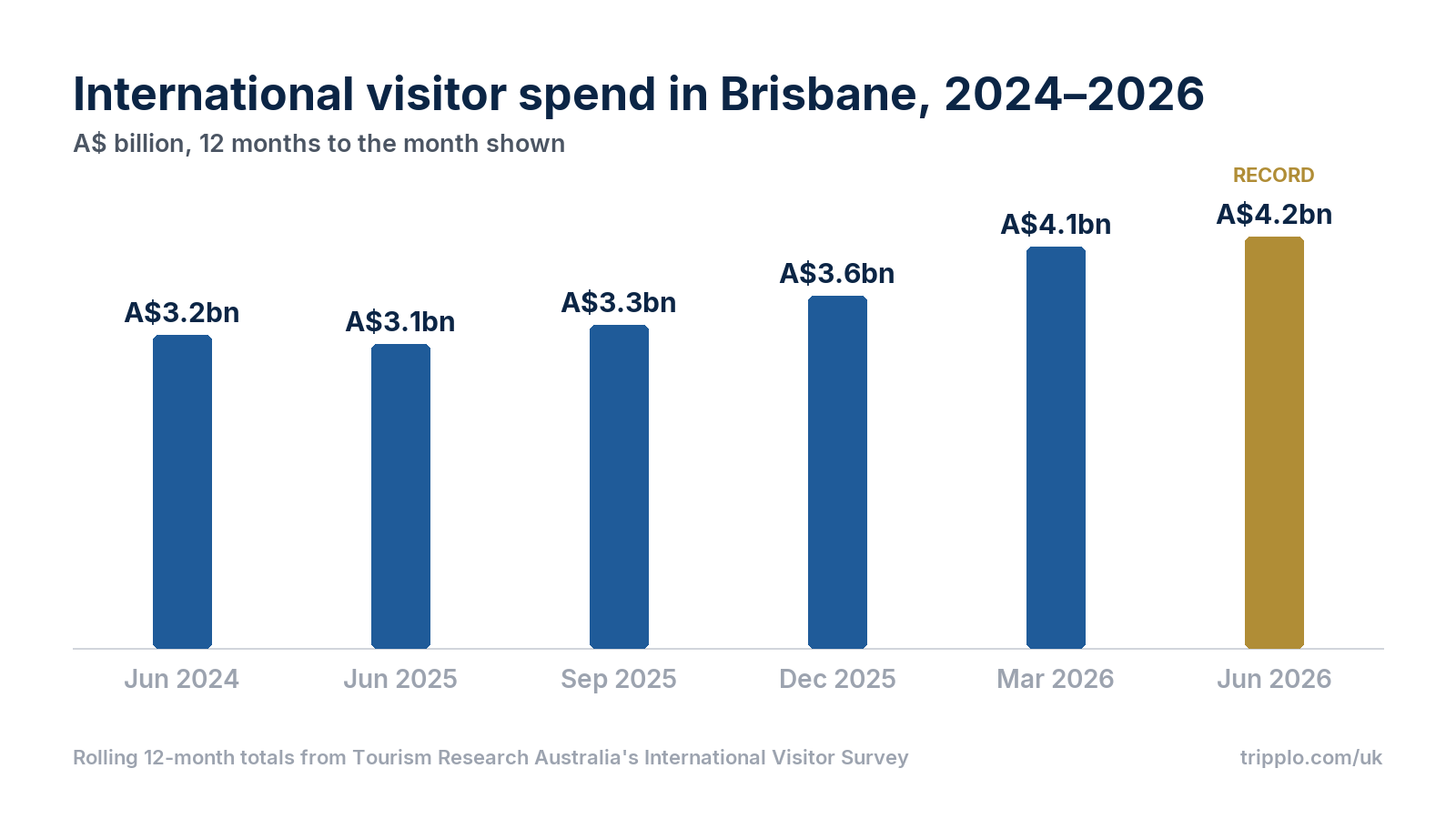
Spending has risen far faster than visitor numbers. In the year ending June 2024, Brisbane drew 1.2 million international visitors, still 15.7% below 2019, even though their spending of A$3.2bn was already 10.1% higher than before the pandemic. International spending then dipped to A$3.1bn in the year ending June 2025 before rising to A$3.3bn (year ending September 2025), A$3.6bn (calendar 2025), A$4.1bn (year ending March 2026) and A$4.2bn (year ending June 2026).
Where Brisbane's international visitors come from
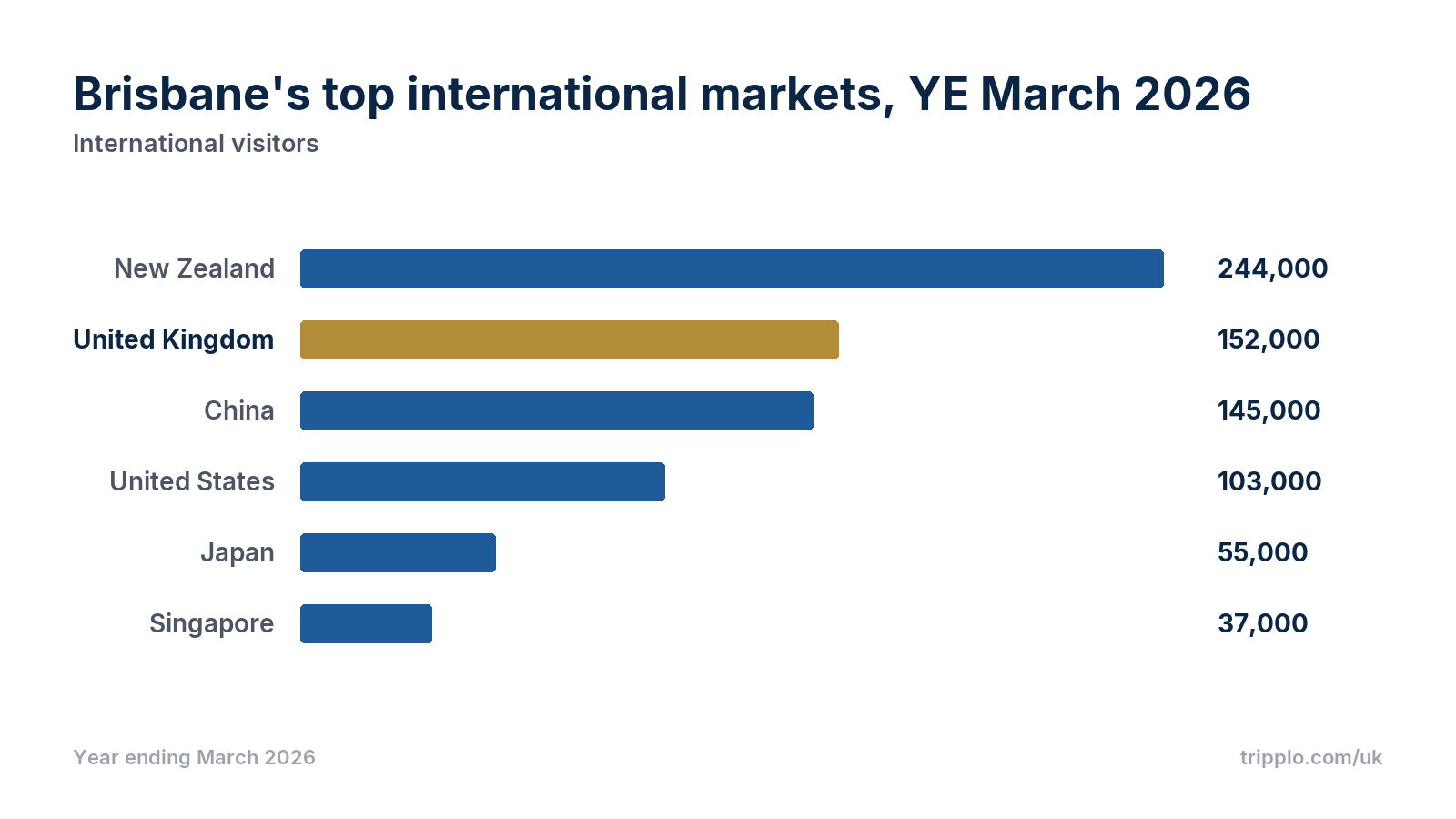
New Zealand is Brisbane's biggest overseas market by visitor numbers, and BEDA describes it as the city's largest inbound market. The fastest growth, however, is coming from Asia and from British holidaymakers.
- New Zealand: 244,000 visitors in the year ending March 2026 (-1.5%).
- United Kingdom: 152,000 visitors (+12.1%). In calendar 2025, UK holiday visitors rose 28.3% to 97,000 and their holiday nights more than doubled to 967,000 (+109.9%).
- China: 145,000 visitors (+29.6%).
- United States: 103,000 visitors (-12.2%).
- Japan: a record 55,000 visitors (+22.8%) staying a record 2.5 million nights.
- Singapore: 37,000 visitors (+53.7%).
Earlier releases add further detail. In the year ending September 2025, South Korea sent 56,000 visitors, India 46,000, Taiwan 46,000 (+40.8%) and France 28,000. Across Queensland, UK visitors spent A$620.9 million in the year ending June 2026 (+9.6%), third behind China and New Zealand among the markets named by the Queensland Government.
Domestic tourism: most of Brisbane's visitor spend
Australians still account for the large majority of Brisbane's visitors and spending. In the year ending March 2026, domestic visitors spent A$13.7bn, 37% of all domestic visitor spending in Queensland (BEDA).
- Domestic overnight spending: A$8.9bn (32% of the Queensland total).
- Day-trip spending: A$4.9bn, almost half (49%) of all day-trip spending in the state.
- Domestic visitor nights: 27.2 million.
- Holiday visitors: 3.4 million, spending A$3.9bn.
- Business visitors: 1.1 million, 43% of Queensland's domestic business visitors, spending A$1.6bn.
New South Wales and Victoria are the main interstate markets. In the year ending June 2024, Brisbane received 1 million visitors from Sydney and 743,000 from Melbourne, both records at the time (BEDA). Comparisons over time need care, however: Tourism Research Australia replaced the National Visitor Survey with the new Domestic Tourism Statistics collection in January 2025, so domestic figures from 2025 onwards are not directly comparable with earlier years.
Brisbane Airport passenger numbers
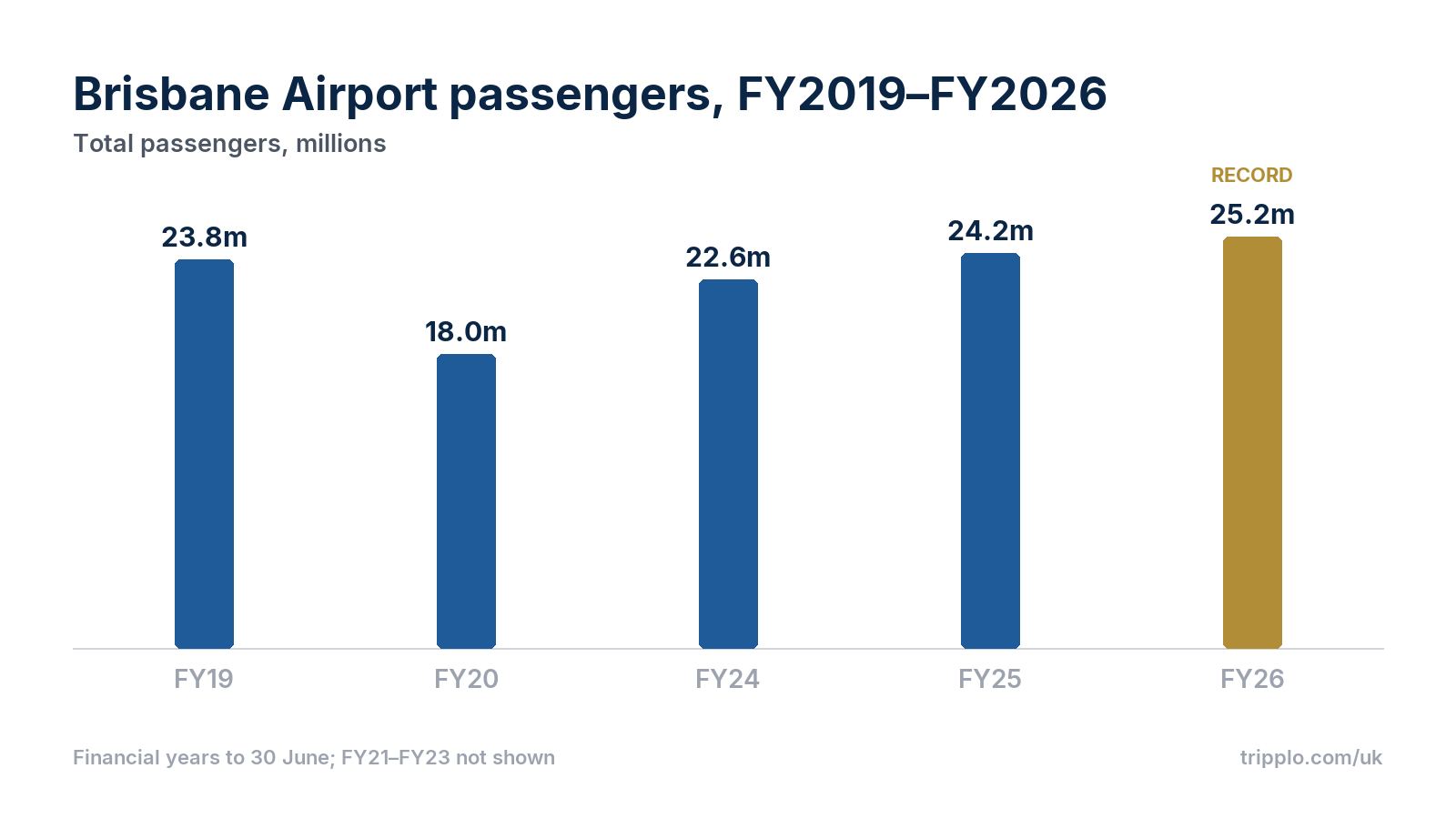
Brisbane Airport is Queensland's main international gateway, and its traffic is now well above pre-pandemic levels.
- FY2018–19: 23.8m passengers, including 6,196,191 international passengers (Brisbane Airport).
- FY2019–20: 18.0m passengers as the pandemic halted travel in the final months of the year.
- FY2023–24: 22.6m passengers, up 12.5% (BEDA).
- FY2024–25: a record 24.2m passengers (+7.2%), including 6,518,653 international passengers (+16.3%) (Brisbane Airport Annual Report 2025).
- FY2025–26: a record 25.2m passengers (25,246,950, +4.0%). International traffic rose 7.9% to 7,080,057 and domestic traffic 2.5% to 18,166,893. Mainland China passengers grew 51.1%.
The airport's figures count every arriving and departing passenger, including residents and transit passengers, so they are higher than the visitor numbers above and should not be read as tourist arrivals.
Seasonality, events and attractions
Brisbane's subtropical climate keeps demand fairly steady through the year, but school holidays, Easter, Christmas and big events produce clear peaks.
- The busiest day in Brisbane Airport's history was 6 October 2025, with 84,265 passengers, after the NRL Grand Final and during the Queensland school holidays.
- In FY2024–25 the busiest overall day was Thursday 17 April 2025, the day before Good Friday, with 82,569 passengers.
- The busiest international day that year was Sunday 22 December 2024, the run-up to Christmas, with 24,368 international passengers. December is also when the city's Christmas markets and festive events draw local and interstate crowds.
- Bluey's World, the attraction based on the children's television series, had welcomed more than 500,000 visitors and generated more than A$156.9 million in economic activity by June 2026 (BEDA).
Major events remain central to the city's strategy ahead of the 2032 Olympic and Paralympic Games, which Brisbane will host.
Jobs, economic weight and the wider Queensland picture
In the year to June 2024, tourism contributed A$12.1 billion to Brisbane's gross regional product, 4.7% of the total, and supported 79,600 jobs, including 45,000 direct tourism jobs (BEDA, Tourism Research Australia regional satellite data).
- Queensland's visitor economy reached A$45.6 billion in the year ending June 2026, A$1.4 billion above the state's Destination 2045 projection (Queensland Government).
- 2.4 million international visitors spent A$8.1 billion across Queensland in that year; international visitation grew 10.6%, against 8.6% nationally.
- Domestic visitors spent A$37.5 billion in Queensland (+3.9%), with 26 million domestic overnight visitors.
- Brisbane's A$4.2bn of international spending is just over half of Queensland's A$8.1 billion total.
- On the Sunshine Coast, north of the city, international visitors spent a record A$424 million in the year ending September 2025, against Brisbane's A$3.3bn in the same period (Queensland Government).
Sources differ slightly on rounding. BEDA's March 2026 release, for example, gives domestic visitor nights as 27.2 million in its data table and 27 million in the text; this page uses the more precise figure.
Sources
- Brisbane Economic Development Agency: Record international spend drives Brisbane's visitor economy to $17.8 billion high (June 2026)
- Brisbane Economic Development Agency: Brisbane's visitor economy surges to $17 billion as international spending hits record high (March 2026)
- Brisbane Economic Development Agency: International visitor spending hits record high in Brisbane (December 2025)
- Brisbane Economic Development Agency: Brisbane welcomes growing wave of international holidaymakers (September 2025)
- Brisbane Economic Development Agency: Brisbane tourism delivers record $12 billion and 80,000 jobs (May 2025)
- Brisbane Economic Development Agency: Brisbane breaks tourism records as visitor spending hits $10.7 billion (September 2024)
- Queensland Government: Queensland visitor economy powers ahead of Destination 2045 projections (September 2026)
- Queensland Government: Summer of spending for Queensland's tourism industry looms (December 2025)
- Brisbane Airport Corporation: Annual Report 2025
- The Moodie Davitt Report: China traffic booms as Brisbane Airport smashes passenger records (August 2026)
- Brisbane Airport: FY20 passenger numbers at BNE plummet due to COVID19 (July 2020)
Luxury travel, straight to your inbox
Every other week we share destinations and hotels worth the journey, from hidden boutique hideaways to classics that live up to their name.