
Key figures
- holiday visits abroad by GB residents in 2025
- 58.4m
- spent by GB residents on holidays abroad in 2025
- £58.8bn
- global leisure travel spending in 2025
- $6.15 trillion
- of UK adults took a holiday, Aug 2025 to Jul 2026
- 88%
- of US/UK business travellers extended trips for leisure, 2024
- 62%
Last reviewed 14 November 2026. Every figure on this page was checked against the sources listed at the end of the page; where two sources disagree, the difference is stated.
Leisure is by far the biggest reason people travel. Residents of Great Britain made 58.4m holiday visits abroad in 2025, 61% of all 95.5m trips overseas, against just 8.2m business trips, according to the Office for National Statistics (ONS). Worldwide, the World Travel & Tourism Council (WTTC) puts leisure spending at $6.15 trillion in 2025, or 80.5% of all travel spending. This page brings together the latest figures from the ONS, VisitBritain, the Great Britain Tourism Survey, ABTA, UN Tourism, WTTC and the Global Business Travel Association (GBTA), as available in November 2026.
Key leisure travel statistics
- UK residents made 99.9m visits abroad in 2025 and spent £86.2 billion (ONS).
- Holidays made up 58.4m of the 95.5m visits abroad by GB residents in 2025, and £58.8 billion of their £83.9 billion spending (ONS).
- Global leisure travel spending rose 3.5% to $6.15 trillion in 2025, 80.5% of all travel spending (WTTC).
- Global business travel spending grew 8.4% to $1.59 trillion in 2025 (GBTA).
- 88% of UK adults took a holiday between August 2025 and July 2026, averaging 3.9 holidays each (ABTA).
- City breaks (53%) overtook beach holidays (49%) as the most popular holiday type in the year to July 2026 (ABTA).
- 62% of US and UK business travellers have extended a work trip for leisure (Amex GBT and Ipsos, surveyed in 2024).
- International tourist arrivals reached about 1.52 billion in 2025, up 4% on 2024 (UN Tourism).
How many leisure trips do Britons take?
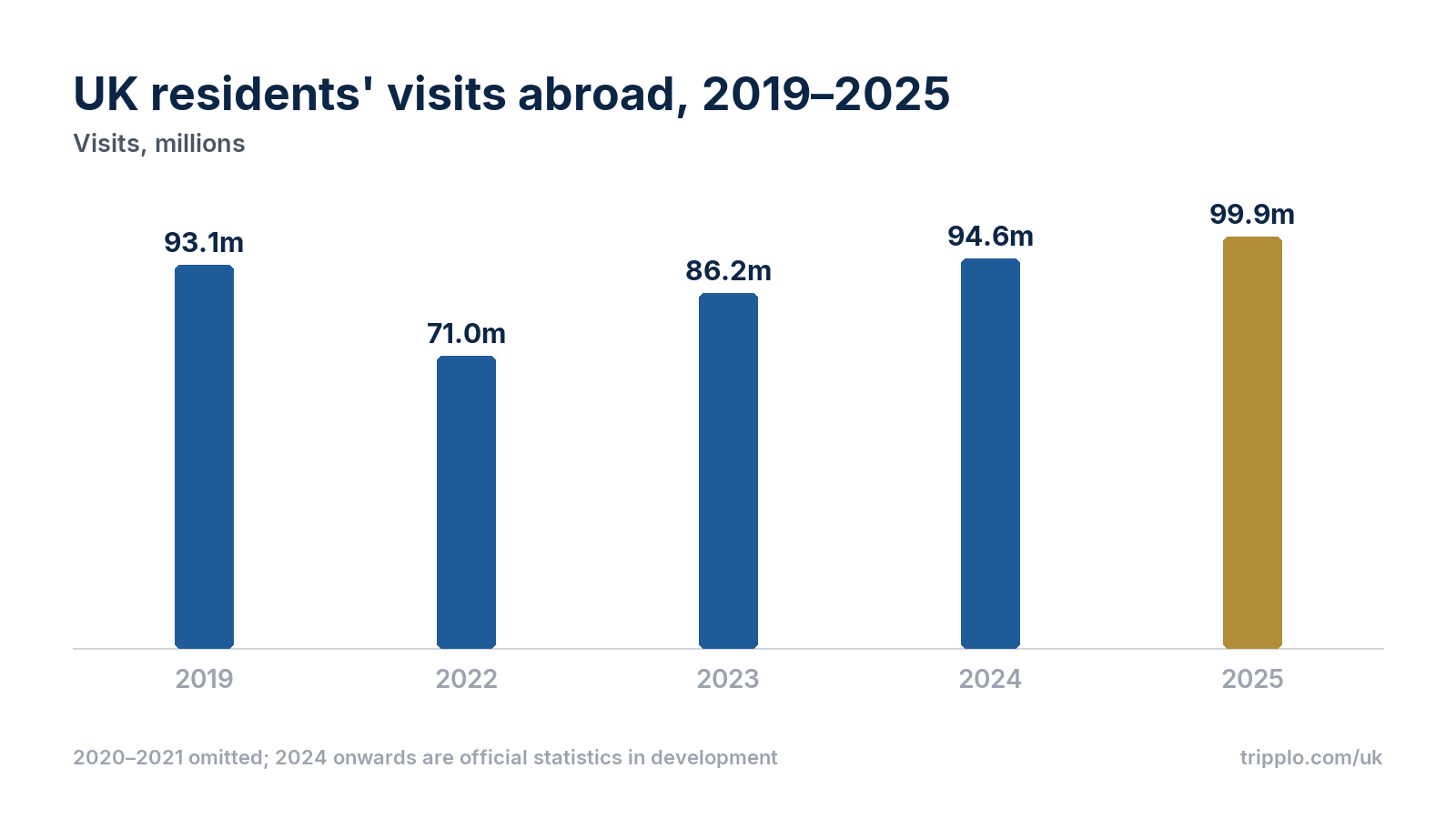
Overseas travel by UK residents has more than recovered from the pandemic. The ONS counted 99.9m visits abroad in 2025, up from 94.6m in 2024, 86.2m in 2023 and 71.0m in 2022. The previous peak, in 2019, was 93.1m. However, the ONS labels its current figures as official statistics in development, and 2024 combines two survey methods, so the year-on-year comparison should be read with some caution.
- Spending abroad by UK residents reached £86.2 billion in 2025, compared with £78.7 billion in 2024 and £72.4 billion in 2023 (ONS).
- Spain was the top destination for GB residents with 19.1m visits in 2025, ahead of France (9.1m) and Italy (5.7m) (ONS).
- ABTA's Holiday Habits survey of 2,082 UK adults found that 88% took a holiday in the 12 months to July 2026, up one percentage point and back to the 2019 level.
- 74% took a UK holiday (the highest in ten years) and 62% went on holiday abroad, almost matching 2019 (ABTA).
- The average person took 3.9 holidays: 2.2 in the UK and 1.7 abroad (ABTA).
- Families travel most: 97% of young families (any child under five) took a holiday, averaging 5.4 trips (ABTA).
Business vs leisure travel: the numbers
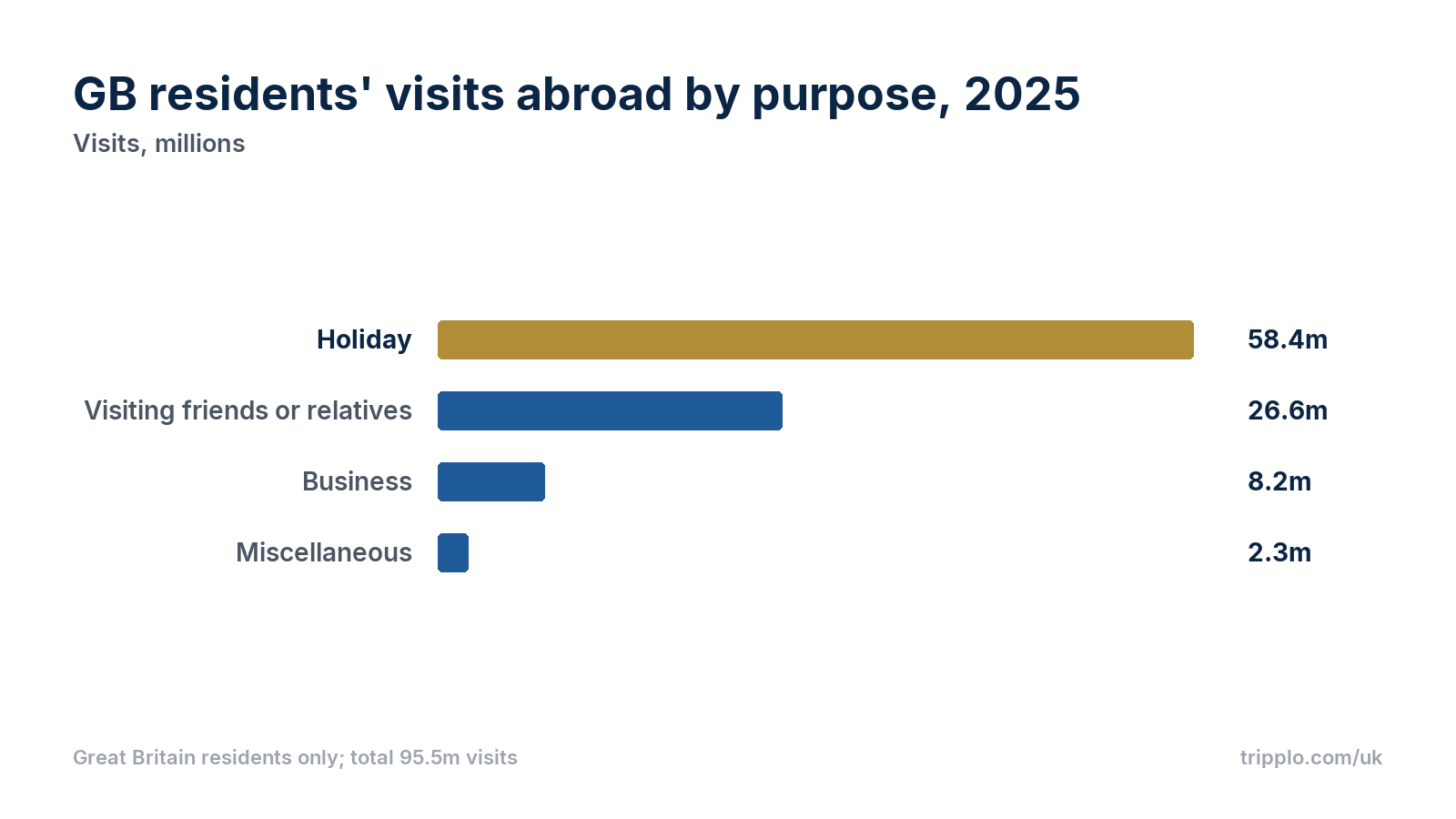
Whichever way the data is cut, leisure trips outnumber business trips by a wide margin. The ONS splits visits abroad by GB residents into four purposes: holidays, visiting friends or relatives (VFR), business and miscellaneous.
- In 2025 GB residents made 58.4m holiday visits, 26.6m VFR visits, 8.2m business visits and 2.3m miscellaneous visits abroad (ONS).
- That means roughly seven holiday trips for every business trip, and holidays accounted for 61% of all visits (Tripplo calculation from ONS figures).
- Package holidays (inclusive tours) made up 28.8m of the holiday visits, with spending of £34.0 billion (ONS).
- Business trips are shorter: 3.9m of the 8.2m business visits lasted one to three nights, while 40.2m holiday visits lasted four to 13 nights (ONS).
- Inbound, overseas residents made 15.1m holiday visits to Great Britain in 2025 (spending £14.5 billion), 12.9m VFR visits (£6.7 billion) and 6.7m business visits (£5.6 billion) (VisitBritain).
- At home, the Great Britain Tourism Survey recorded 32.06m domestic holiday trips, 37.01m VFR trips and 6.28m business trips in 2025. Business trips rose 7% while holiday trips fell 1%.
The global picture is similar. WTTC estimates that leisure accounted for 80.5% of world travel spending in 2025. GBTA, which measures corporate travel separately, puts business travel spending at $1.59 trillion for the same year, across about 1.82 billion business trips. The two organisations use different methods, so their totals should not be added together.
Leisure spending in the UK and worldwide
Holidays also dominate what Britons spend on travel. Of the £83.9 billion GB residents spent abroad in 2025, £58.8 billion (70%) went on holidays, £13.0 billion on VFR trips, £9.5 billion on business trips and £2.6 billion on miscellaneous visits (ONS).
- A holiday abroad cost about £1,007 per visit in 2025, a package holiday about £1,184 and a business trip about £1,163; a VFR trip cost about £489 (Tripplo calculation from ONS figures).
- Domestic overnight spending in Great Britain rose 7% to £35,106 million in 2025, of which £12,395 million was on holidays (up 3%) and £3,778 million on business trips (up 23%) (Great Britain Tourism Survey).
- GB residents made 1,061.15 million tourism day trips in 2025, up 3%, spending £55,997 million (Great Britain Tourism Survey).
- Average weekly household spending reached £676.60 in the year to March 2025. Spending on package holidays abroad rose by £5.80 a week (21%) in cash terms and £4.10 (14%) after inflation (ONS Family Spending).
- Household spending on recreation and culture rose by £6.70 a week (9%) in real terms over the same year (ONS Family Spending).
- Worldwide, international tourism receipts reached about $1.9 trillion in 2025, up 5%; the UK was among the top earners, with receipts up 9% (UN Tourism).
- Europe captured about $2 trillion of global leisure spending in 2025, roughly one dollar in every three (WTTC).
What kind of holidays people take
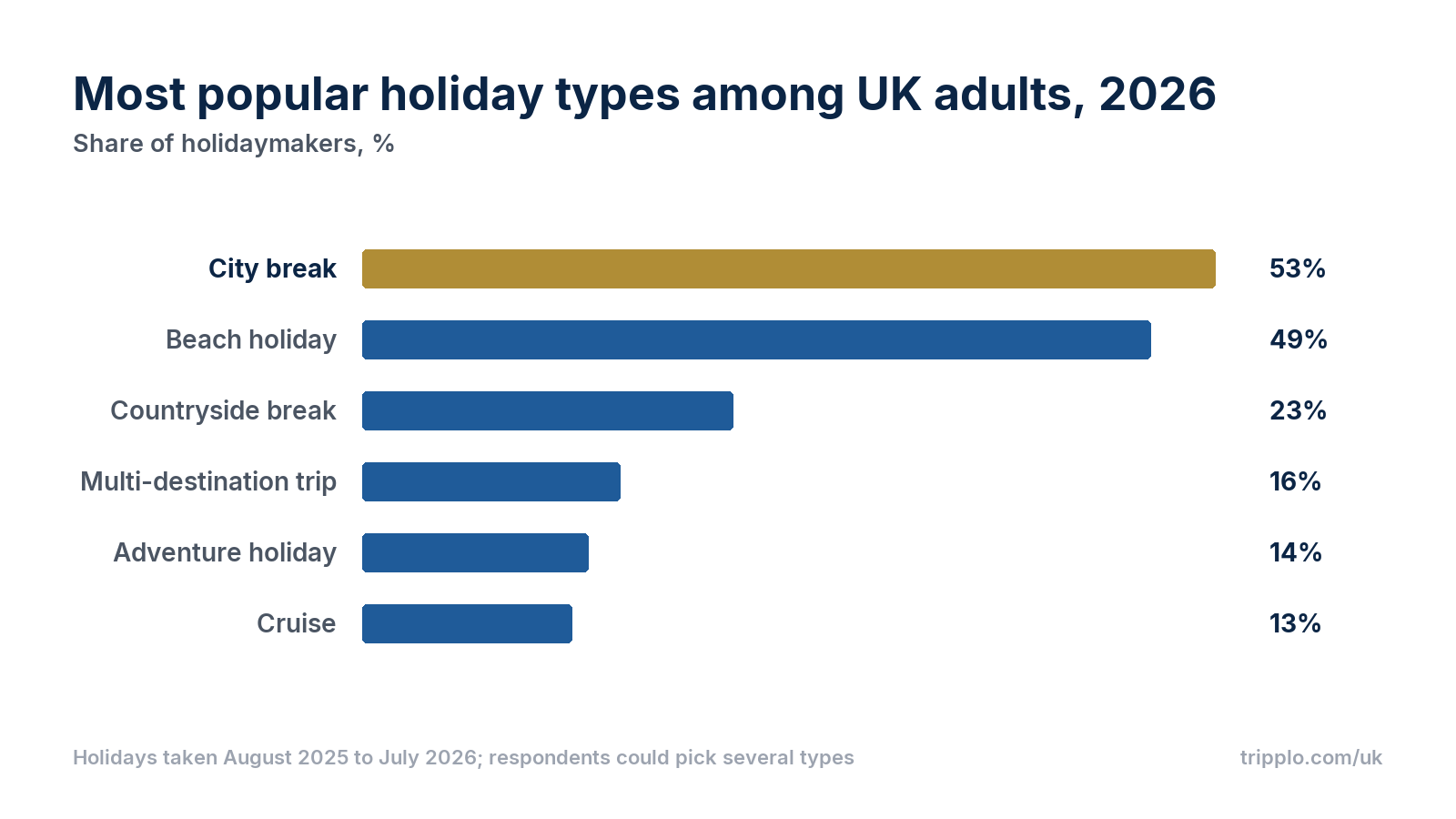
The type of trip is shifting. In ABTA's 2026 survey, city breaks rose six percentage points to 53% of holidaymakers and overtook beach holidays (49%) as the most popular type overall. Countryside breaks came third at 23%, followed by multi-destination trips (16%), adventure holidays (14%) and cruises (13%). Families, however, still prefer the beach: 57% of them took a beach holiday.
- Spain was the most visited country among UK holidaymakers (36%), followed by France (24%), Italy (15%), the USA (14%) and Greece (12%) (ABTA).
- 63% of those who went abroad booked a package, up two percentage points; best value for the price was the main reason (48%) (ABTA).
- All-inclusive was chosen by 33% of those who holidayed abroad, and by 43% of families abroad (ABTA).
- 38% booked their holiday abroad with a travel agent or tour operator, up from 34% (ABTA).
- Solo travel keeps growing: 21% travelled alone, up two percentage points (ABTA).
Bleisure: where business and leisure meet
The line between work trips and holidays is blurring. A survey of 1,817 business travellers in the US and the UK (817 of them British), carried out by Ipsos for American Express Global Business Travel in September 2024, found that 62% had extended a work trip for leisure. Another 52% had done the reverse, fitting work meetings into a holiday.
- Earlier research found a lower share: in 2017 a GBTA Foundation study found that 37% of North American business travellers had extended a work trip for leisure in the previous year. The two surveys cover different countries and years, so the comparison is indicative only.
- The same 2017 study found millennials (48%) far more likely to add leisure days than Generation X (33%) or baby boomers (23%) (GBTA).
- Official statistics do not count bleisure directly. The ONS puts visits that combine business and holiday, with neither purpose dominant, into its miscellaneous category, which totalled 2.3m trips abroad by GB residents in 2025.
Leisure travel trends for 2026 and 2027
Demand is holding up, although the mood is more cautious. ABTA's Travel Confidence Index stood at +50 in August 2026, down from +53 a year earlier. In May 2026, amid conflict in the Middle East, jet fuel concerns and queues at Europe's new Entry/Exit System, a reading would have been only +26.
- 32% of holidaymakers plan to spend more on holidays in the next 12 months, down from 34%; 15% plan to spend less, and only 7% say rising costs would stop them going on holiday at all (ABTA).
- When cutting back, people are more likely to trim holidays abroad (32%) than UK holidays (23%) (ABTA).
- WTTC forecasts global leisure spending to grow 3.1% in 2026, with Europe ahead at 3.7%.
- GBTA expects business travel spending to reach a record $1.71 trillion in 2026 (up 7.2%), while business trips grow only 1.3% to 1.84 billion, meaning higher prices rather than more trips.
- UN Tourism expects international tourism to grow by 3% to 4% in 2026, provided economic conditions stay favourable and conflicts do not escalate.
- WTTC forecasts travel and tourism to contribute $12 trillion to the world economy in 2026, 9.9% of global GDP, supporting 376 million jobs.
Sources
- ONS: Travel trends: 2025
- ONS: UK residents' visits abroad, 2025 dataset
- ONS: Travel trends: 2024
- ONS: Travel trends: 2023
- ONS: Family spending in the UK, April 2024 to March 2025
- VisitBritain: Inbound visits and spend, annual, UK
- Welsh Government: Domestic GB tourism statistics 2025 (provisional), Great Britain Tourism Survey
- ABTA: Holiday Habits 2026-27
- UN Tourism: International tourist arrivals up 4% in 2025
- WTTC: Europe captures one-third of global leisure travel spending
- WTTC: Global travel and tourism growth to outpace wider economy over the next decade
- GBTA: Business Travel Index 2026 forecast (via Hospitality Net)
- American Express Global Business Travel and Ipsos: Meet Tomorrow's Business Travelers (via Hospitality Net)
- GBTA: Mixing work and play, new study profiles the bleisure traveler
Luxury travel, straight to your inbox
Every other week we share destinations and hotels worth the journey, from hidden boutique hideaways to classics that live up to their name.