
Last reviewed 14 November 2026. Every figure on this page was checked against the sources listed at the end of the page; where two sources disagree, the difference is stated.
Germany recorded 497.5m overnight stays in hotels, holiday homes and campsites in 2025, a new record and 0.3% more than in 2024, according to the Federal Statistical Office (Destatis). Foreign guests accounted for 83.8m of those nights, down 1.8% after the boost from the 2024 European Football Championship, and the OECD counts 37.1 million international tourists for 2025, 0.8% fewer than a year earlier. The figures below come mainly from Destatis, the Deutsche Bundesbank, the German Travel Association (DRV), the OECD and WTTC, and include Destatis releases for January–September 2026.
Key Germany tourism statistics
- Germany counted a record 497.5m overnight stays in 2025 (+0.3%), of which 413.7m were by domestic guests and 83.8m by guests from abroad (Destatis).
- Around 37.1 million international tourists visited Germany in 2025, down 0.8% on 2024 (OECD).
- Foreign guests made up 16.8% of all overnight stays in 2025, down from 17.2% in 2024 (Destatis).
- The Netherlands was the largest source market in 2025 with 11.7m overnight stays, followed by the USA and Switzerland; the UK ranked fourth with 4.7m (Destatis, via iwd).
- Berlin was the most-visited city in 2025 with 12.4m guest arrivals and 29.4 million overnight stays (Amt für Statistik Berlin-Brandenburg).
- Foreign visitors spent €37.8bn in Germany in 2025 according to the Bundesbank's travel balance, almost level with €38.0bn in 2024.
- WTTC projected that travel and tourism would contribute €499 billion, or 11.6% of GDP, in 2025 and support 6.5 million jobs.
- 2026 is running slightly ahead: January–September 2026 brought 389.8 million overnight stays (+0.6%), with foreign guests up 1.5% to 65.0 million (Destatis).
How many tourists visit Germany each year?
Germany measures tourism mainly in overnight stays in accommodation with at least ten beds (or ten pitches on campsites), so the answer depends on which yardstick you use.
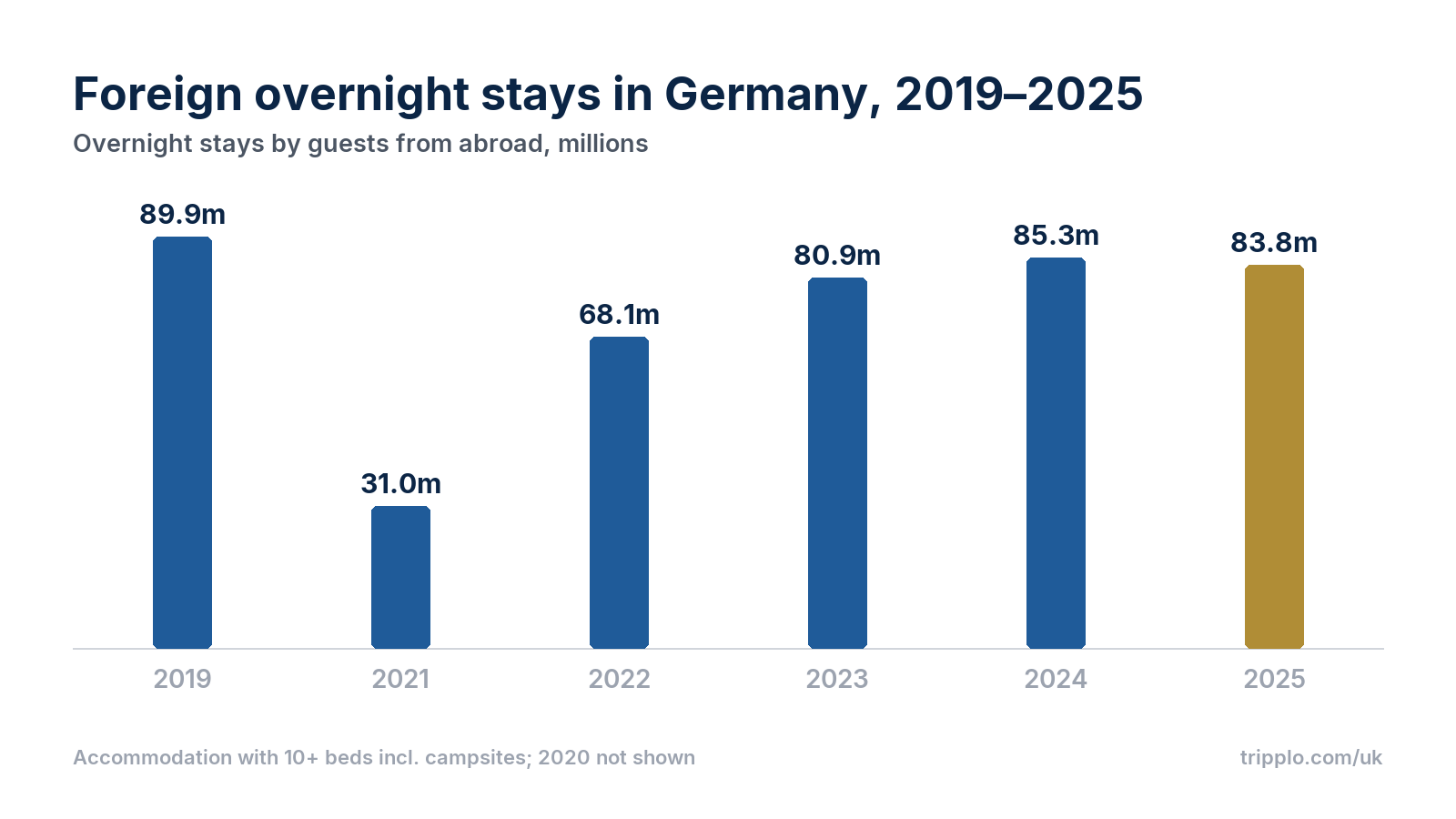
- Overnight stays: guests from abroad spent 83.8m nights in German accommodation in 2025, against 85.3m in 2024 and 80.9m in 2023 (Destatis; DRV).
- International tourists: the OECD puts the number of international tourists at 37.1 million in 2025 and notes that Germany was one of four OECD countries where arrivals fell that year, along with Canada, Ireland and the United States.
- Total nights, all guests: the February 2026 Destatis release gives 497.5m for 2025; a later Destatis camping release and the Institut der deutschen Wirtschaft (iwd) give 497.4m. The small gap reflects revisions to provisional data.
The long view shows a recovery that has not quite finished. Foreign overnight stays peaked at 89.9m in 2019, the last year before the pandemic (Destatis). They had sunk to 31.0m by 2021, then climbed to 68.1m in 2022, 80.9m in 2023 and 85.3m in 2024, the latter still 5.1% below 2019 (Destatis; DRV). Domestic demand, however, has fully recovered: German residents spent 413.7m nights away from home in their own country in 2025, compared with 405.7 million in 2019, which is why the overall total keeps setting records while the foreign figure lags behind.
Where visitors come from: the Netherlands leads
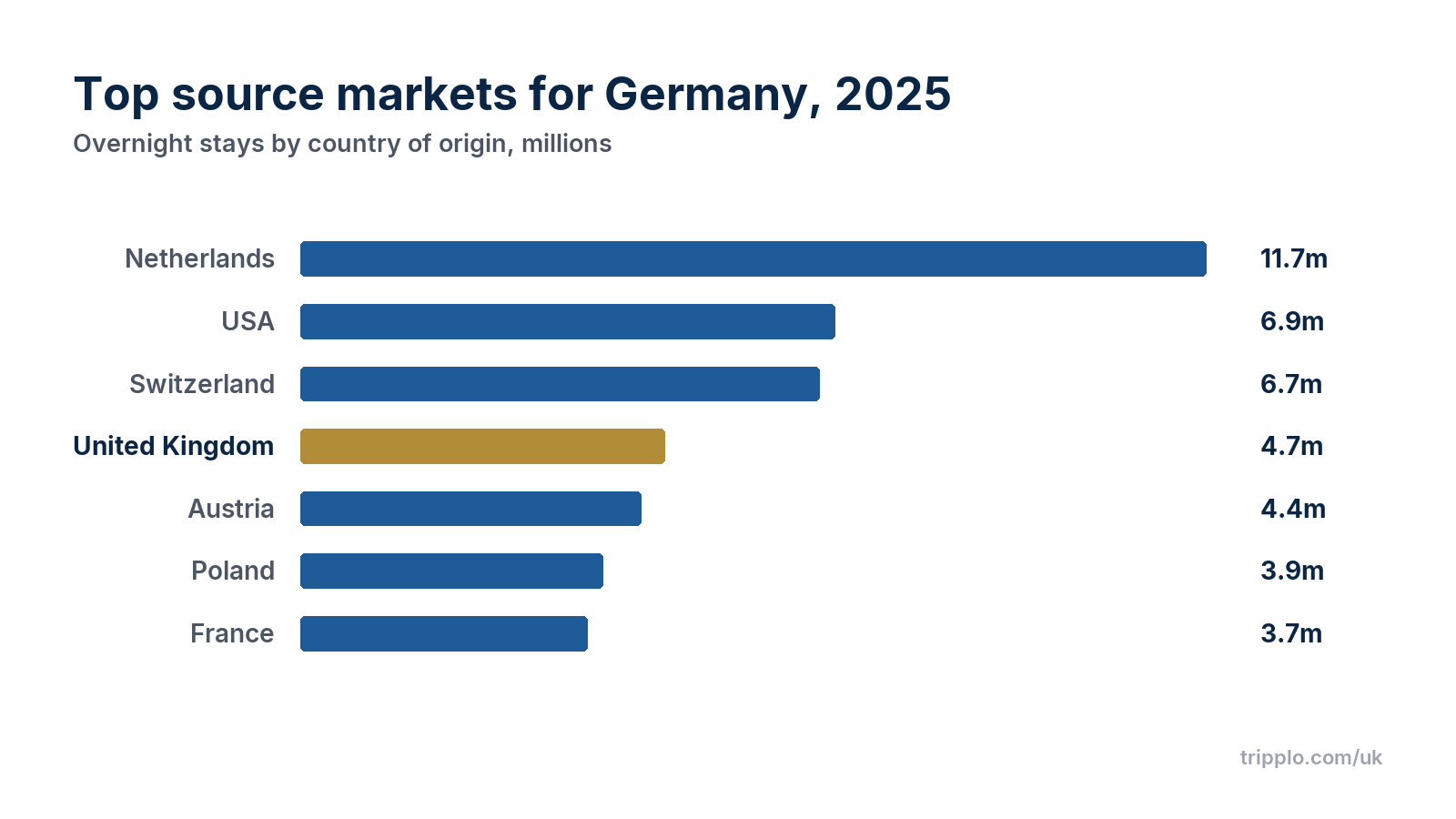
Neighbouring countries dominate inbound travel to Germany: seven of the top ten markets share a border with it. Destatis data published by iwd give the following overnight stays for 2025:
- Netherlands: 11.7m nights, or 14.1% of all foreign overnight stays (DRV).
- USA: 6.9m nights (8.2%), the only country outside Europe in the top ten.
- Switzerland: 6.7m nights (8.1%).
- United Kingdom: 4.7m nights (5.5%).
- Austria: 4.4m (5.3%), Poland: 3.9m (4.7%) and France: 3.7m (4.4%).
- Italy (3.5 million), Belgium (3.1 million) and Denmark (3.0 million) complete the top ten.
For British readers, the picture is mixed. The UK is Germany's fourth-largest foreign market by nights, yet Bundesbank figures show that receipts from UK visitors fell to €1.555 billion in 2025 from €1.778 billion in 2024. In Berlin, British overnight stays dropped 9.1% to 1.27 million in 2025, leaving the UK just behind the United States (1.28 million) as the capital's biggest foreign market (Amt für Statistik Berlin-Brandenburg).
Most visited cities in Germany
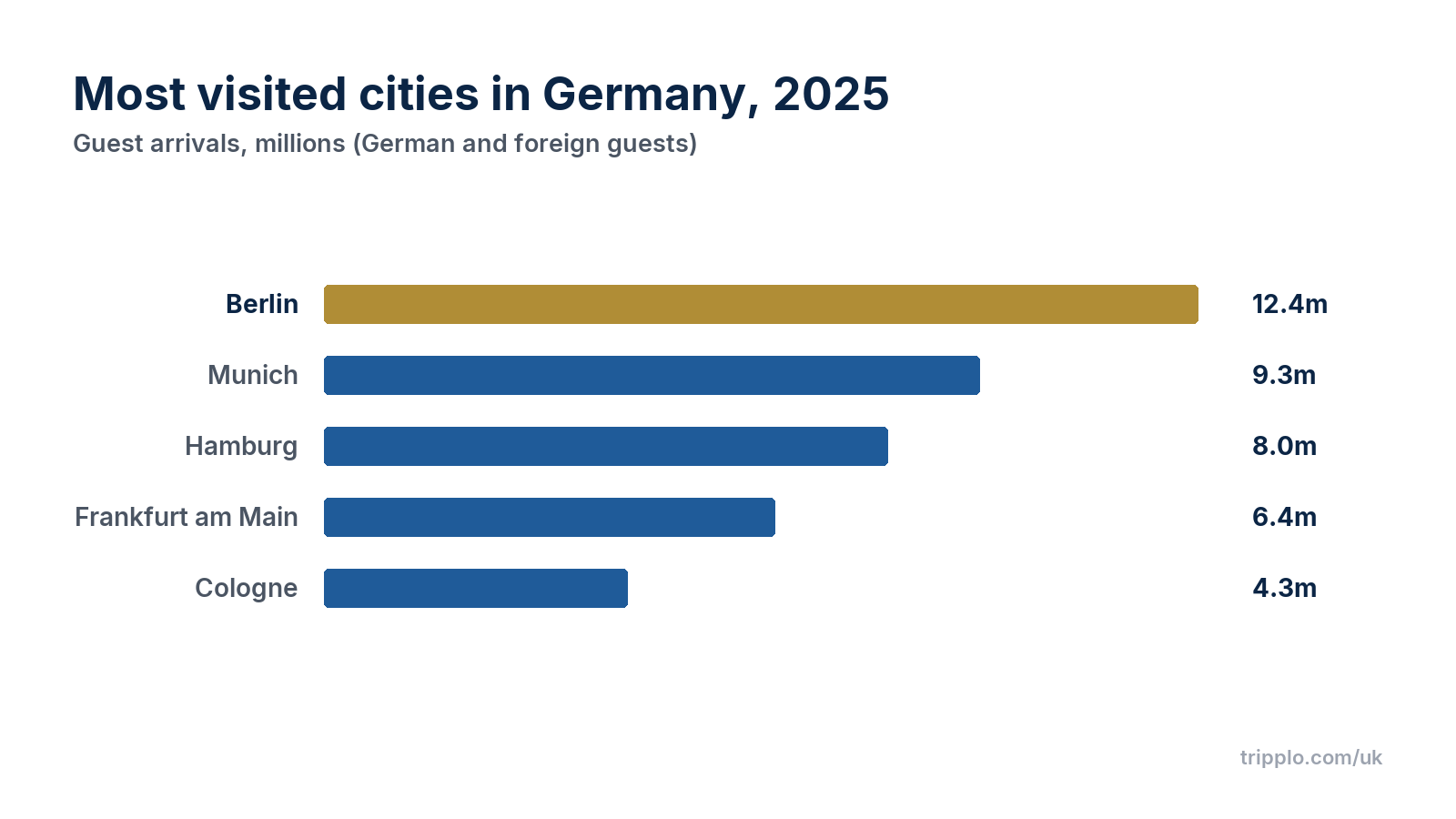
The five most popular city-break destinations for German and foreign visitors in 2025, measured by guest arrivals, were (DRV, citing the state statistical offices):
- Berlin: 12.4m guest arrivals (12.7 million in 2024).
- Munich: 9.3m, unchanged on 2024.
- Hamburg: 8.0m, up from 7.6 million.
- Frankfurt am Main: 6.4m, level with 2024.
- Cologne: 4.3m, up from 4.2 million.
How many tourists visit Berlin each year?
- Berlin welcomed 12.4 million guests in 2025 who booked 29.4 million overnight stays, down 2.7% and 3.8% respectively on 2024, when the city passed 30 million nights (Amt für Statistik Berlin-Brandenburg).
- International guests accounted for 41.1% of Berlin's overnight stays; guests from elsewhere in Europe made up 70.4% of all foreign nights.
- Among foreign markets, overnight stays grew most strongly from Luxembourg (+20.3%), China and Hong Kong (+14.4%) and India (+10%).
- Hotels with at least 25 rooms reported room occupancy of 73.5%, in line with 2024, and almost half of all nights (46.0%) were spent in the central Mitte district.
- The Berlin Senate puts tourist consumption in the city at €15.1 billion, with 224,800 people depending directly or indirectly on tourism.
Gateways: Frankfurt and Munich airports
- Frankfurt Airport handled about 63.2 million passengers in 2025 (+2.6%), still around ten per cent below pre-pandemic levels (Fraport).
- Munich Airport served 43.4 million passengers in 2025, up 4.4% on 2024 (Munich Airport, provisional).
Spending and the tourism economy
Two official-looking numbers for visitor spending circulate, and they measure different things. The Bundesbank's balance-of-payments figures record what foreign travellers spend in Germany; WTTC uses its own, broader methodology.
- Bundesbank: travel receipts from foreign visitors rose from €29.8bn in 2022 to €35.0bn in 2023 and €38.0bn in 2024, before easing to €37.8bn in 2025.
- The Netherlands generated the most receipts in 2025 (€4.6 billion), ahead of Poland (€3.6 billion), France (€3.4 billion), Switzerland (€3.3 billion) and the USA (€3.1 billion) (Bundesbank).
- Germans spend far more abroad than visitors spend in Germany: travel expenditure reached €118.5 billion in 2025, giving a large travel deficit (Bundesbank).
- WTTC: international visitor spending was €45.1 billion in 2024 and was forecast to reach a record €57 billion in 2025, with domestic spending of €425 billion. WTTC also projected a total economic contribution of €499 billion (11.6% of GDP) and 6.5 million jobs (14% of employment) for 2025, rising to €579 billion by 2035.
Official statistics give a narrower picture of tourism's weight in the economy. The OECD reports a direct contribution of €122.3 billion, or 3.1% of GDP, in 2022, the latest year of official tourism accounts, with 1.9 million people (4.2% of employment) working directly in tourism. The DRV cites 2.9 million employees in the tourism industry, equal to 7% of all jobs. The gap between 3.1% and 11.6% comes down to method: the official figure covers tourism's direct contribution only, while WTTC estimates the sector's total contribution on its own model, and the years differ too.
Seasonality, regions and accommodation
- Peak season: August is the busiest month. In August 2025 Germany recorded 59.4 million overnight stays, including 9.8 million by foreign guests (Destatis).
- Low season: December 2025 brought 32.0 million nights, roughly half the August level, though it was still the strongest December on record (+3.6%) (Destatis).
- Regions: Bavaria accounts for about a fifth of all overnight stays, followed by Baden-Württemberg and North Rhine-Westphalia with just over 11% each (iwd).
- Hotels: hotels, guesthouses and inns take around 60% of all nights, holiday homes and similar lodgings about 20%, and campsites 9% (iwd). Hotel nights dipped 0.4% in 2025 (Destatis).
- Camping: campsites set a record with almost 44.7 million overnight stays in 2025, 4.2% more than in 2024 and 24.9% above 2019. The Schleswig-Holstein Baltic coast was the leading camping region with 3.5 million nights (Destatis).
- Hospitality capacity: the DRV lists 29,147 hotel businesses with 998,910 rooms, an average room rate of €111 and average room occupancy of 67.7% (end of 2024, German Hotel Association).
Germany tourism in 2026 so far
- Destatis counted 389.8 million overnight stays in January–September 2026, 0.6% more than the record 387.6 million of the same period in 2025.
- Foreign guests grew faster than domestic ones: 65.0 million nights (+1.5%) against 324.7 million domestic nights (+0.4%).
- Momentum was uneven. August 2026 fell 1.1% to 58.7 million nights, yet foreign stays that month rose 1.3% to 9.9 million; September 2026 then added 0.8%, with foreign nights up 4.8% to 8.1 million (Destatis).
- Policy is shifting in favour of the industry: VAT on restaurant food was cut from 19% to 7% from 1 January 2026, and the national tourist board's 2026 budget for promotion abroad is €40.6 million (OECD).
- The September figures are provisional; Destatis plans to publish detailed results at the end of November 2026.
Sources
- Destatis: Tourismus in Deutschland im Jahr 2025 (press release No. 046, February 2026)
- Destatis: Tourismus in Deutschland im Jahr 2024 (press release No. 053, February 2025)
- Destatis: Camping boomt weiter, 44,7 Millionen Übernachtungen im Jahr 2025
- Destatis: Tourismus in Deutschland im August 2025
- Destatis: Tourismus in Deutschland im August 2026
- Destatis: Tourismus in Deutschland im September 2026
- HOGAPAGE: Zehnter Übernachtungsrekord für Deutschland in Folge (Destatis 2019 figures)
- iwd (Institut der deutschen Wirtschaft): Rekordjahr für die Tourismusbranche
- DRV (German Travel Association): Facts and Figures 2026
- Deutsche Bundesbank: Balance of payments statistics, travel by region (annual results)
- OECD: Tourism Trends and Policies 2026, Germany
- WTTC: Germany's Travel & Tourism sector to break all-time records in 2025
- Amt für Statistik Berlin-Brandenburg: Tourismus 2025 in Berlin (press release 18-2026)
- Berlin Senate Department for Economics: Tourismusbilanz 2025
- Fraport: Traffic Figures 2025
- Munich Airport: Munich Airport continues its growth trajectory in 2025
Luxury travel, straight to your inbox
Every other week we share destinations and hotels worth the journey, from hidden boutique hideaways to classics that live up to their name.