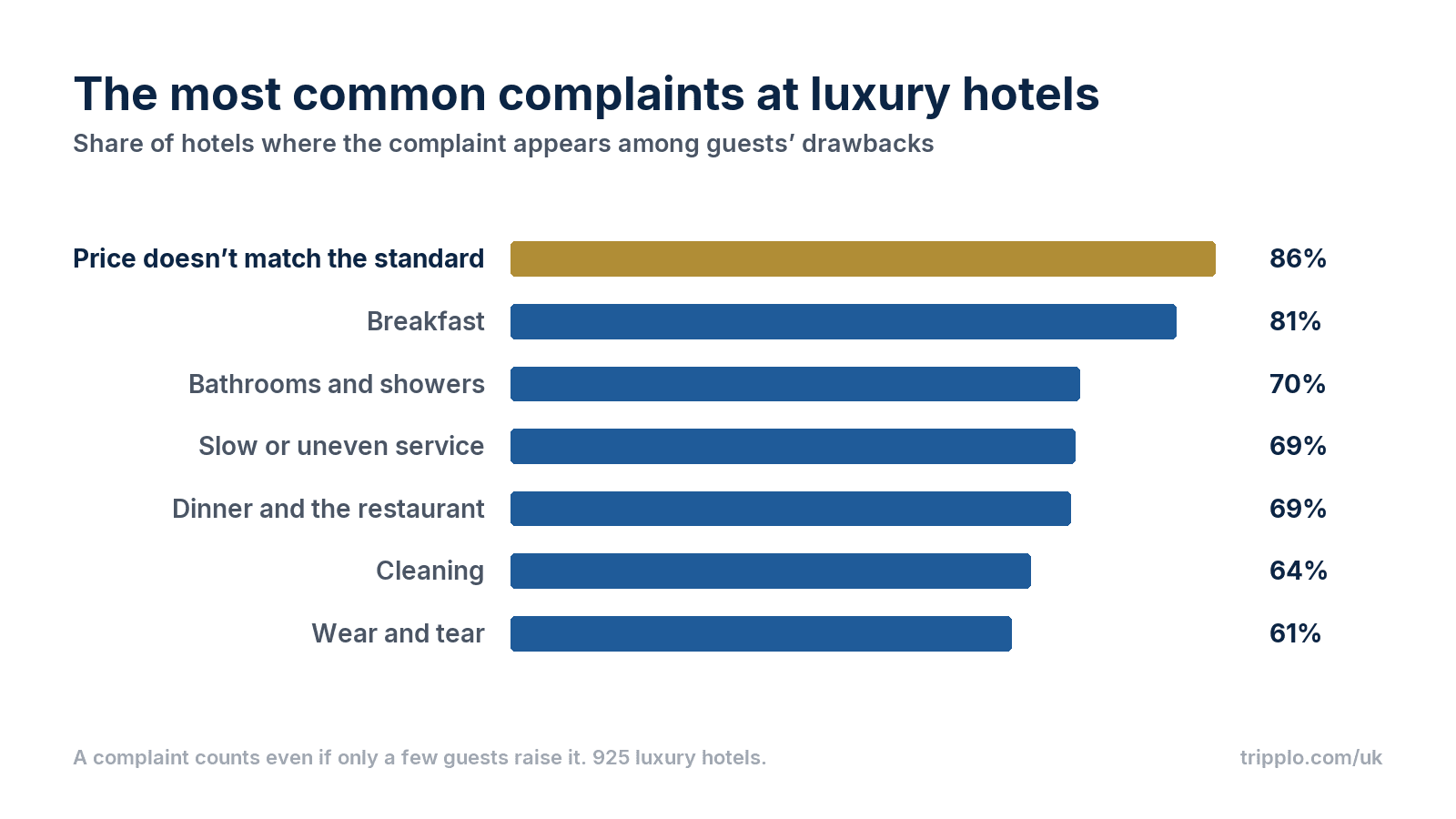

In short: The most common complaint at luxury hotels is that the price doesn’t match the standard. It comes up at 86% of the hotels we analysed, followed by breakfast, bathrooms and showers, slow service and dinner. After value for money, noise is the topic guests are most likely to criticise when they mention it. At all-inclusive hotels, food draws the most criticism; at city hotels, the rooms and the service do.
A luxury hotel promises a lot, so when something falls short, guests notice. We went through 55,840 guest reviews from 929 luxury hotels in 24 countries, from Italy and Greece to Thailand and the Maldives, to see what guests actually complain about. The reviews were collected from Booking.com between August and October 2026, and every one was read and sorted by the topics it covers.
The results are not especially dramatic. Complaints are rarely about disasters and almost always about everyday things that should simply work at a hotel in this price bracket: breakfast, the shower, noise from the street and the feeling of having paid too much.
Which areas draw the most criticism?
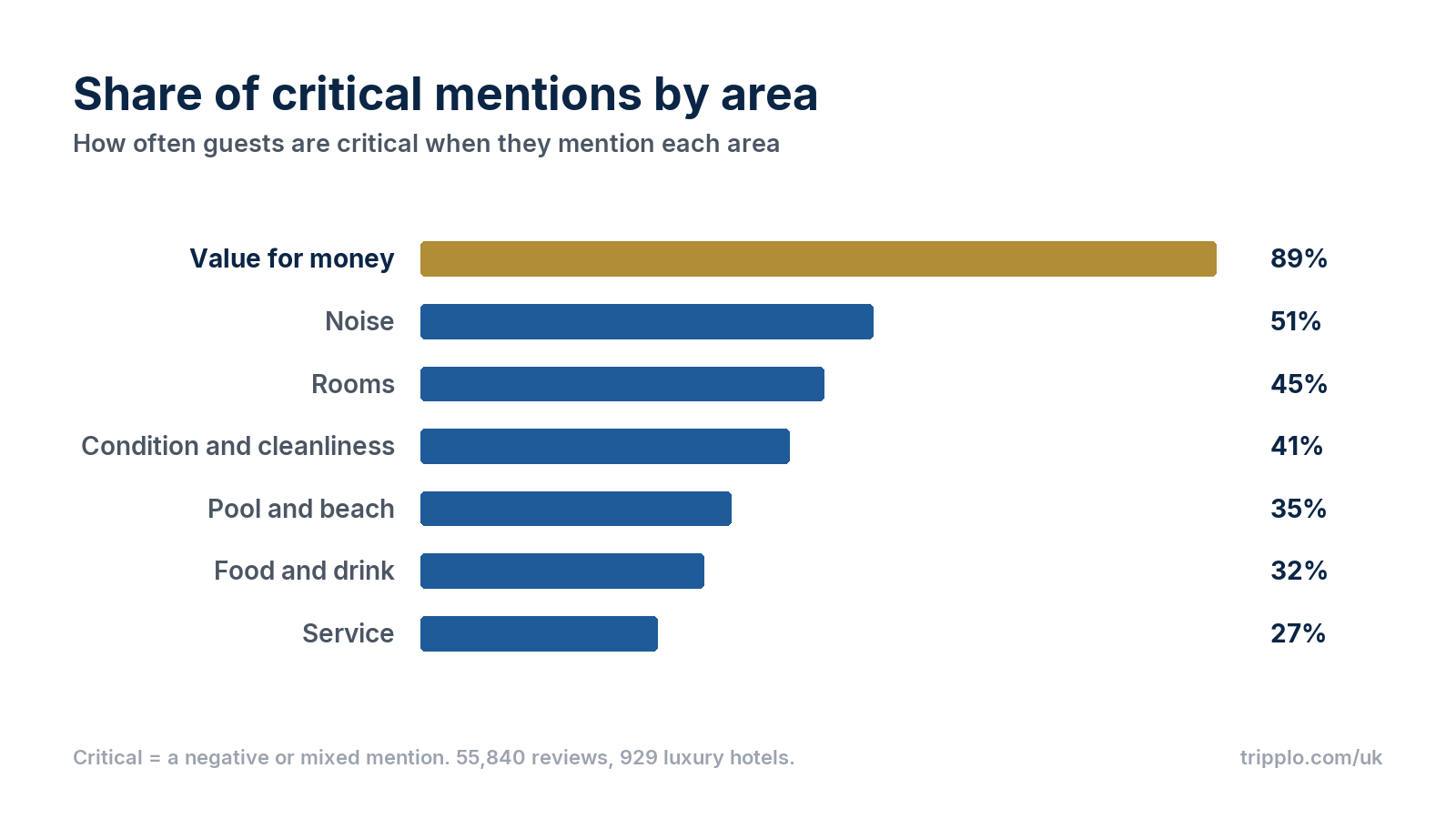
We divided everything guests write into eight areas: rooms, service, food and drink, condition and cleanliness, pool and beach, noise, location, and value for money. For each area we worked out what share of the mentions were negative or mixed.
Value for money stands out. When a guest brings up the price at all, it is a complaint 89% of the time. Happy guests tend to write about the room or the staff, whereas unhappy ones raise the price. Noise comes next at 51%, followed by the rooms (45%) and condition and cleanliness (41%).
Location draws the least criticism, with only 10% of mentions critical, and service comes in at 27%. Staff, however, are what guests write about most, so even a small share of criticism adds up to a lot of reviews.
The most common complaints
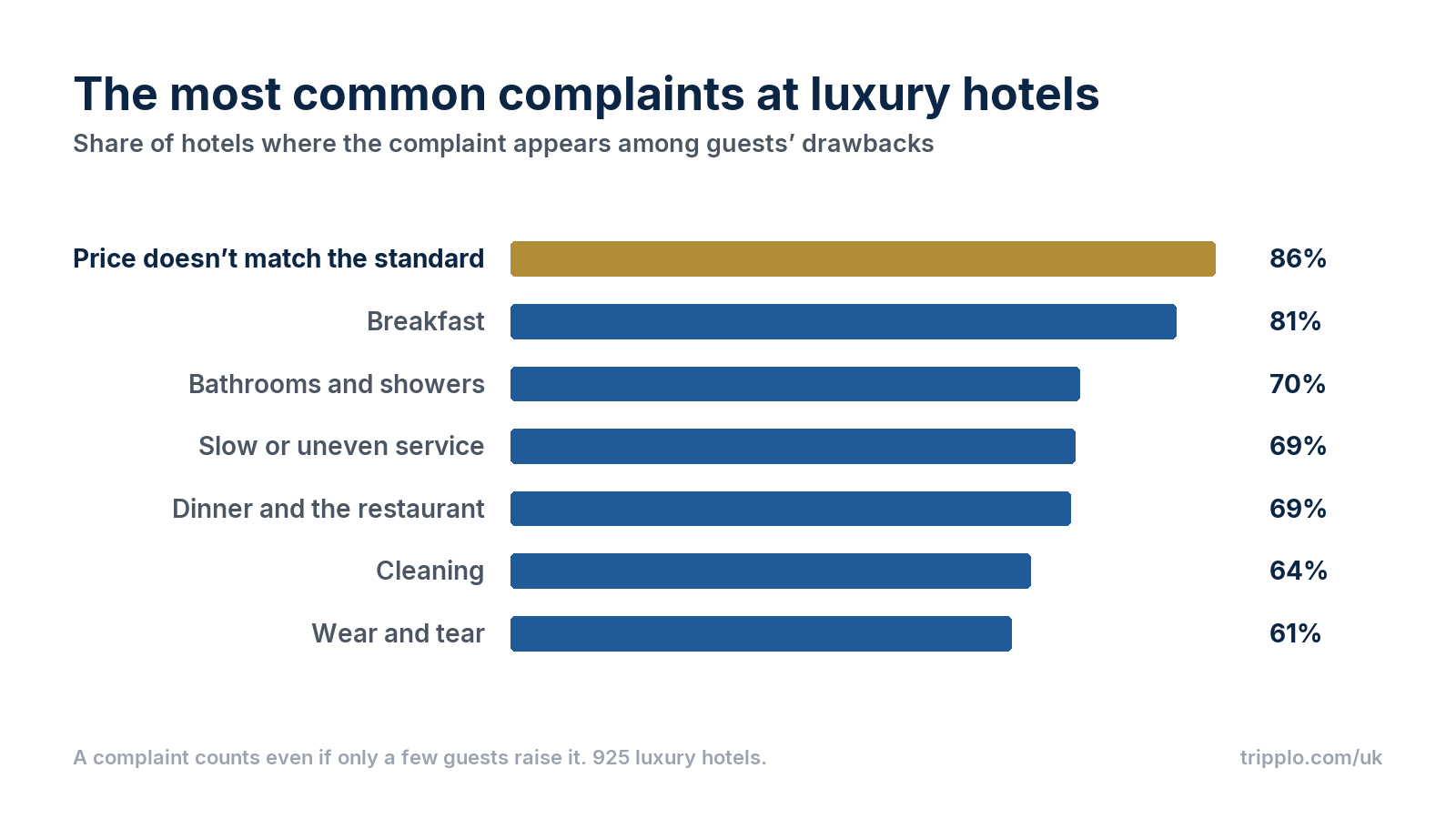
The areas show broadly where hotels fall short. To see exactly what goes wrong, we went through the recurring drawbacks hotel by hotel and counted how many hotels share each complaint. For each hotel, these drawbacks sum up what its guests complain about: usually issues that come up again and again, though occasionally a single, specific observation.
1. The price doesn’t match the standard
This complaint appears at 86% of hotels. It is rarely about the room rate itself and far more often about the gap between the price and what the guest actually gets: a small room, a worn bathroom or a breakfast that costs extra. At just over a third of hotels (37%), guests also say that food and drink at the hotel are expensive, and unexpected fees and supplements come up just as often.
“Charged extra for Eggs Benedict when pretty much all the ingredients were available separately. For 5 stars and the price we expected more.”
Guest review, rated 4 out of 10
How to avoid it: check what is included in the rate before you book, particularly breakfast, the spa and parking. Two hotels charging the same per night can end up a long way apart once the extras are added.
2. Breakfast
Breakfast appears among the drawbacks at 81% of hotels, and it is no surprise that it ranks so high: almost every guest eats breakfast, and most of them at roughly the same time. Guests complain about queuing for a table, empty platters that nobody refills, the same spread day after day and coffee that isn’t up to scratch.
“Breakfast was chaotic on most mornings and we recommend they put in place a booking system. The staff tried their best but were run ragged.”
Guest review, rated 8 out of 10
How to avoid it: go early or late, when fewer guests are eating. Check, too, whether breakfast is a buffet or ordered from a menu. Some guests are disappointed simply because they expected one and got the other.
3. Bathrooms and showers
The bathroom appears among the drawbacks at 70% of hotels. The usual culprits are poor water pressure, hot water that runs out, slow drains and showers that leave the floor flooded. Some guests also object to glass-walled bathrooms with no proper door.
How to avoid it: look at the photos of the room type you are actually booking, not the hotel’s best suite. A room listed with a “bath with shower” may simply have a hand-held shower in the bath.
4. Slow or uneven service
This complaint appears at 69% of hotels, but the tone is different from the other complaints. Guests rarely call the staff bad; they call them inconsistent: reception is excellent while the restaurant is short-staffed, or the other way round. Complaints about unfriendly staff come up at just over half the hotels (54%).
“Service was a bit hit and miss. We felt a bit invisible at times and had to go and find staff to order drinks/food.”
Guest review, rated 7 out of 10
5. Dinner and the restaurant
Dinner gets a mention at 69% of hotels. Guests complain about restaurants that close on certain evenings, à la carte tables that are hard to book, small portions and a menu that starts to feel limited after a few days. At almost one in four hotels (23%), guests say the buffet gets repetitive on a longer stay.
6. Cleaning and wear and tear
Cleaning comes up at 64% of hotels and wear and tear at 61%. These are the reviews most clearly shaped by expectations: a slightly tired hotel can be perfectly acceptable, just not at a five-star price.
“Our room was dusty and dirty. It definitely needed a refresh and a good clean.”
Guest review, rated 6 out of 10
How to avoid it: sort the reviews by date and read the latest ones first. A hotel may have been refurbished, or begun to look tired, since the older reviews were written.
Other recurring complaints
- The pool (61% of hotels): too small, too cold, too crowded or closed without warning.
- Small rooms (56%): often with little storage space.
- Air conditioning and heating (53%): rooms that won’t cool down or warm up.
- Thin walls between rooms (51%) and traffic and street noise (49%).
- Beds and pillows (43%): usually beds that are too firm.
- Sun loungers and towels (32%): too few loungers, and guests bagging them with towels first thing in the morning.
- Building work (19%): at the hotel or nearby.
Wi-Fi, by contrast, comes up at only 5% of hotels.
How complaints differ by type of hotel
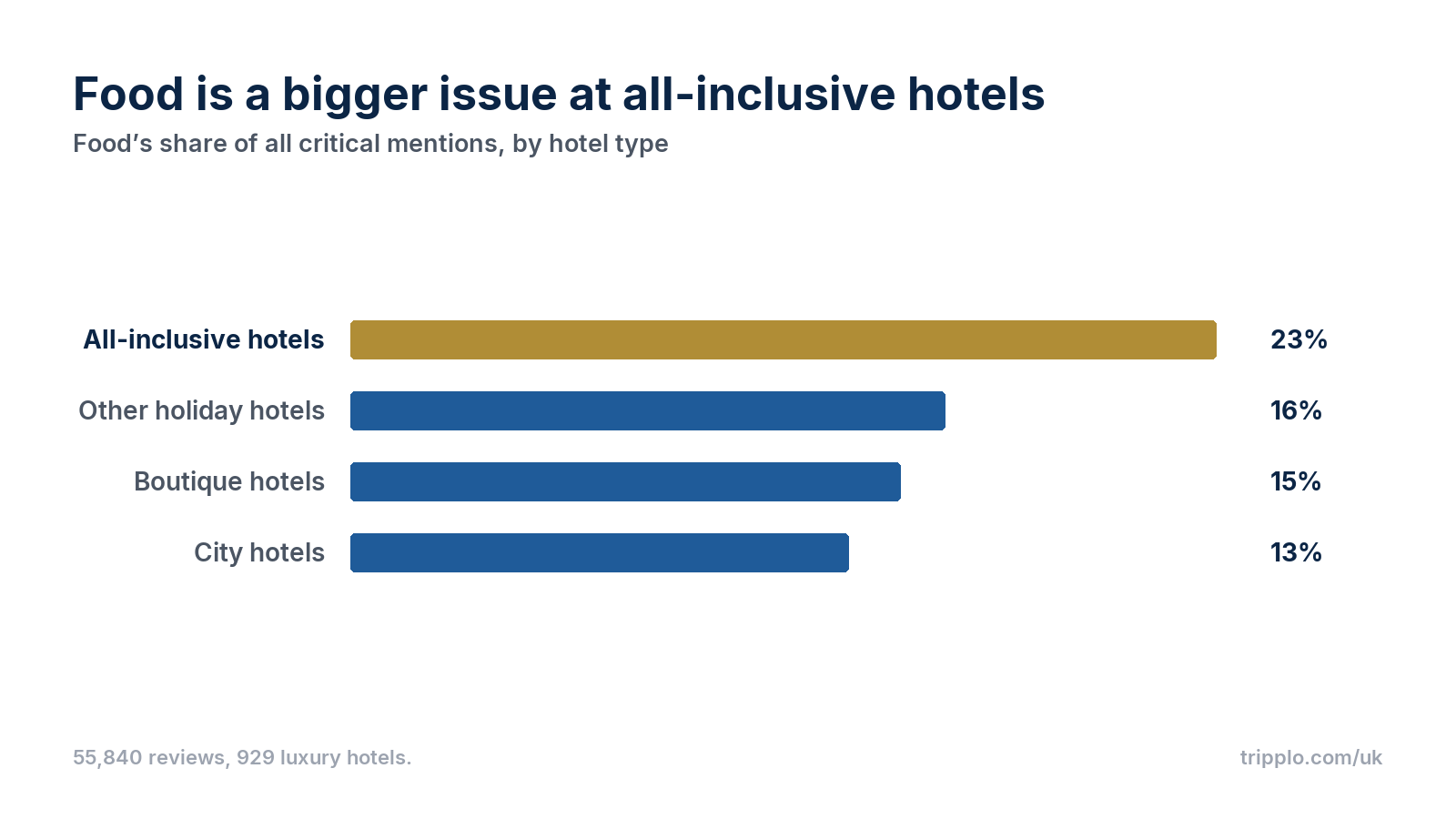
What bothers guests depends a great deal on the kind of hotel they stay in. We sorted the hotels into four groups and worked out how the criticism in each group is split across the eight areas.
All-inclusive hotels (47 hotels): food accounts for 23% of all criticism, more than at any other type of hotel. That makes sense, since guests eat every meal on site and notice when the buffet starts to repeat itself. The pool and beach also draw more criticism here than elsewhere.
City hotels (395 hotels): the rooms and the service together account for 45% of the criticism. Noise is a particular sore point in cities. When guests at city hotels mention noise, it is a complaint 59% of the time, typically about traffic, trams, bin lorries or a bar in the building.
“I’m glad I took my ear plugs and eye mask… the curtains let in the early morning sunshine and the noise from the street disturbed me the first night but ear plugs helped the other nights.”
Guest review, rated 9 out of 10
Boutique hotels (125 hotels): service draws less criticism here than in any other group. Only 19% of comments about the staff are critical, compared with 30% at city hotels. The rooms, on the other hand, are the weak spot, accounting for 22% of the criticism. They are often described as small and sometimes as oddly laid out.
Other holiday hotels (362 hotels): beach, island and countryside hotels that are not all-inclusive. Here the criticism is spread fairly evenly, and service attracts the most.
How complaints differ by destination
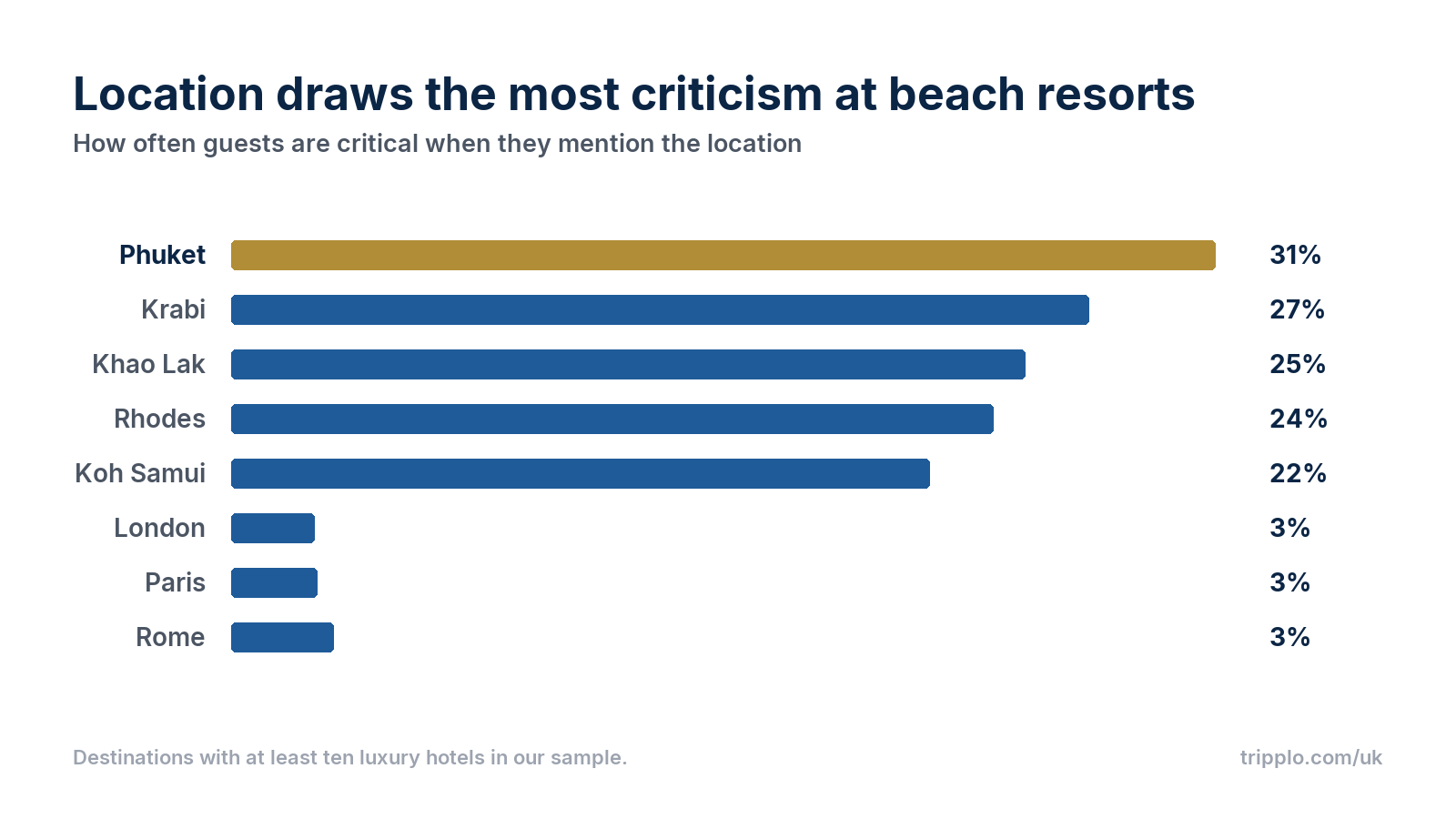
Where guests travel shapes what they complain about, too. We compared the destinations for which we have at least ten luxury hotels in our sample, and in four areas the differences are big enough to bear in mind when you are deciding where to go.
Location: beach resorts versus big cities
In London, Paris and Rome, only 3% of mentions of the location are critical. At the Thai beach resorts, the share is much higher: 31% in Phuket, 27% in Krabi, 25% in Khao Lak and 22% on Koh Samui. On Rhodes, the figure is 24%. Guests write that the hotel is a long way from town, that there is little within walking distance and that they end up relying on taxis or a hire car. At the larger hillside resorts, guests also often have to take a golf buggy between their room, the restaurant and the beach.
How to avoid it: check the map to see how far the hotel is from the nearest town and beach. If you want to be able to walk to a restaurant in the evening, the distance matters a great deal.
Noise: lively coastal resorts and big cities
When guests in Marbella mention noise, it is a complaint 79% of the time. In Madrid the figure is 74% and in Milan 68%. Guests describe music from restaurants, bars and clubs going on late into the night, and walls so thin that they can hear the neighbours and anyone passing in the corridor. In Tuscany and on Lanzarote, by contrast, the figures are just 27% and 26%, and in Berlin 23%.
Service: Dubrovnik, Berlin and Hamburg stand out
Of the destinations we compared, service draws the most criticism in Dubrovnik (39% of mentions), followed by Berlin and Hamburg (36% each). Guests mention a frosty welcome at reception, slow service when the hotel is busy and having to ask for things more than once. On the Amalfi Coast and on Mykonos, the figures are only 14% and 15% respectively.
Rooms: the Maldives in a league of their own
In the Maldives, only 19% of mentions of the rooms are critical, compared with 45% across the sample as a whole. Guests there generally stay in villas on the beach or over the water. In Sweden, the figure is 59%, the highest of any country with at least ten hotels in our sample.
How to avoid the most common disappointments
- Check what is included: breakfast, parking, the spa and any charges payable at the hotel.
- If you are a light sleeper, ask for a room away from the street, the lift and the bar. It costs nothing to ask in advance.
- Read the most recent low-scoring reviews. They show whether the complaints are about things that would bother you.
- Ask about any refurbishment or building work before you book.
- At all-inclusive hotels, check how many à la carte restaurants are included and whether they need booking.
Every hotel page on Tripplo has a summary of what guests like and what they complain about, broken down into the same areas as this analysis.
How we did it
The analysis is based on 55,840 guest reviews from 929 luxury hotels, collected from Booking.com between 19 August and 20 October 2026. For each hotel we took the most recent reviews along with the highest- and lowest-rated ones, so that both satisfied and dissatisfied guests are represented. Each review was sorted by the areas it covers and by whether the verdict was positive, negative or mixed.
Because we deliberately included the lowest-rated reviews, the share of criticism in our sample is higher than it would be across all reviews. The figures therefore show what guests complain about, and in what order, not how often guests at luxury hotels are dissatisfied. The share of hotels for each complaint is based on the recurring drawbacks for 925 hotels, as four hotels had no drawbacks recorded. We do not name any hotels in this analysis, and quotes are reproduced verbatim.
Sources
- Tripplo review analysis of 929 luxury hotels, guest reviews from Booking.com, August–October 2026.
Frequently Asked Questions
Luxury travel, straight to your inbox
Every other week we share destinations and hotels worth the journey, from hidden boutique hideaways to classics that live up to their name.